The best 3PL company for your business depends on your catalog, sales channels, and order profile. Our US ecommerce shortlist includes 10 providers: Red Stag Fulfillment for heavy, bulky, and high-value goods; ShipBob for distributed ecommerce fulfillment; ShipMonk for subscription boxes and crowdfunding batches; Amazon FBA for the Amazon store; LVK for apparel on Shopify; Renewal Logistics for apparel restoration and returns; DCL Logistics for complex products and retail; Buske Logistics for warehousing plus DTC; Saddle Creek Logistics for integrated omnichannel operations; and Speed Commerce for personalization and kitting.
Disclosure: Red Stag Fulfillment publishes this guide and is included in the list. Recommendations reflect the documented services, with selected public sources shown alongside each provider profile below. For size and revenue comparisons, see the biggest 3PL companies.
Key takeaways
- Match the provider to your catalog first: heavy and high-value goods, apparel, subscription boxes, and complex electronics all narrow the field quickly.
- Advertised services aren’t audited performance. Treat every profile here as a starting point, then request a proposal with your real SKUs.
- Compare storage, pick and pack, receiving, returns, minimums, and exit fees, never just the per-order rate.
- Ask every finalist the same question set so proposals are actually comparable.
| Quick comparison by operational fit | ||||
|---|---|---|---|---|
| Provider | Best fit | Documented operating profile | Key condition to resolve | Sources |
| Red Stag Fulfillment | Heavy, bulky, and high-value ecommerce | US facilities in Tennessee and Utah; client-cost loss/damage reimbursement and error-correction shipping in published guarantee | Map ground transit from both hubs to your customer map | Sources |
| ShipBob | Distributed ecommerce fulfillment | Inbound to one hub, then distribution and rebalancing across US sites; durable-goods support including heavy/fragile | Get written SKU acceptance and packaging rules; heavy/fragile is a special setup, not standard inclusion | Sources |
| ShipMonk | Subscription boxes, crowdfunding batches, kitting | Facilities in North America, UK, and mainland Europe; batch fulfillment documented | Monthly minimum calculation; batches under 50 identical orders incur a setup fee (checked September 10, 2026) | Sources |
| Amazon FBA | Sellers whose primary channel is the Amazon store | Storage, pick/pack/ship, customer service, and returns for FBA orders; Prime eligibility for eligible FBA products; separate MCF service for non-Amazon orders | Run the Revenue Calculator on your actual SKUs; model fees for large, heavy, or slow-moving inventory | Sources |
| LVK | Apparel brands on Shopify, plus multichannel DTC/B2B | Formerly ShipHero Fulfillment; ShipHero WMS ties; documented Shopify integration | Apparel counting/verification can incur per-unit or hourly charges; noncompliant inbound costs more | Sources |
| Renewal Logistics | Apparel returns processing, restoration, retail prep | Returns sorting and first-quality resale disposition; pressing, cleaning, refurbishment; also ecommerce/retail/wholesale fulfillment | Confirm which services run at which Georgia or California site | Sources |
| DCL Logistics | Complex products: electronics, serialization, light assembly | DTC, retail, B2B, and Amazon channels; eFactory visibility platform; ISO 9001 quality management | Verify the specific controls your regulated category requires; ask what work is in-house vs. subcontracted | Sources |
| Buske Logistics | Combined contract warehousing/distribution plus DTC | DTC pick and pack, marketplaces, B2B/wholesale, returns, kitting; industrial and food-beverage contexts | Ask how DTC programs are staffed and which facilities serve your channels | Sources |
| Saddle Creek Logistics | Integrated omnichannel warehousing, fulfillment, transportation | Nationwide US network; services offered separately or as an integrated package | Confirm services and transport coverage at proposed sites; verify minimums in the proposal | Sources |
| Speed Commerce | Personalization, kitting, value-added order work | Embroidery, engraving, complex kitting, gift wrap, returns refreshing; Deposco-powered dashboards; contact center | Ask how customization affects cutoff times, peak capacity, and per-order fees | Sources |
How we compared these 3PL companies
This selective, qualitative shortlist covers ten providers with documented US fulfillment services and distinct buyer use cases. We checked the linked public sources on September 10, 2026. It is not an exhaustive market ranking.
We cover providers serving needs like heavy and high-value goods, distributed inventory, subscription and batch fulfillment, Amazon-centric selling, apparel, returns-heavy businesses, complex electronics, combined B2B and DTC operations, omnichannel scale, and personalization work. We exclude a size or revenue leaderboard. For those comparisons, see our biggest 3PL companies guide.
We did not run test orders, interview providers, collect live quotes, or independently measure service performance. Public pages describe advertised capabilities and sometimes publish performance metrics, but without common measurement definitions we don’t use them to rank accuracy, on-time shipping, or peak performance. The presentation order below is the article’s structure, not a measured performance ranking. For most providers, pricing and service-level commitments require a proposal based on your SKUs; Amazon publishes program rate cards, but your total still depends on the services and inventory involved. Our guide to choosing a 3PL walks through the fuller diligence process.
Provider comparison
The “best for” labels identify a reason to shortlist each provider, based on documented capabilities. Fit still has to be confirmed through a proposal built on your actual SKUs and references from businesses with similar requirements.
Red Stag Fulfillment
Best for: heavy, bulky, and high-value ecommerce products.
Red Stag specializes in big, heavy, and bulky ecommerce fulfillment, and for high-value inventory the cost of a lost or damaged unit makes contractual accountability a central part of the decision. Our published guarantee policy commits us to reimburse the client’s cost for lost or damaged items, ship to the service-level agreement we agree to, make same-day shipping available, and cover the shipping costs of fixing our own mistakes, including getting incorrect items back.
Our footprint is US-focused: the specialist service page states that our Tennessee and Salt Lake City, Utah locations can reach 96% of the US population within two days by ground, checked September 10, 2026. That’s our stated ground-transit reach, not a promise every order arrives in two days. If you need inventory stored outside the US, that’s a different footprint than ours.
Fit decision: if your SKUs are large, heavy, fragile, or expensive, get our proposed handling requirements in writing before signing.
Sources: Specialist service page, fulfillment service guarantees.
ShipBob
Best for: distributed ecommerce fulfillment across multiple US locations.
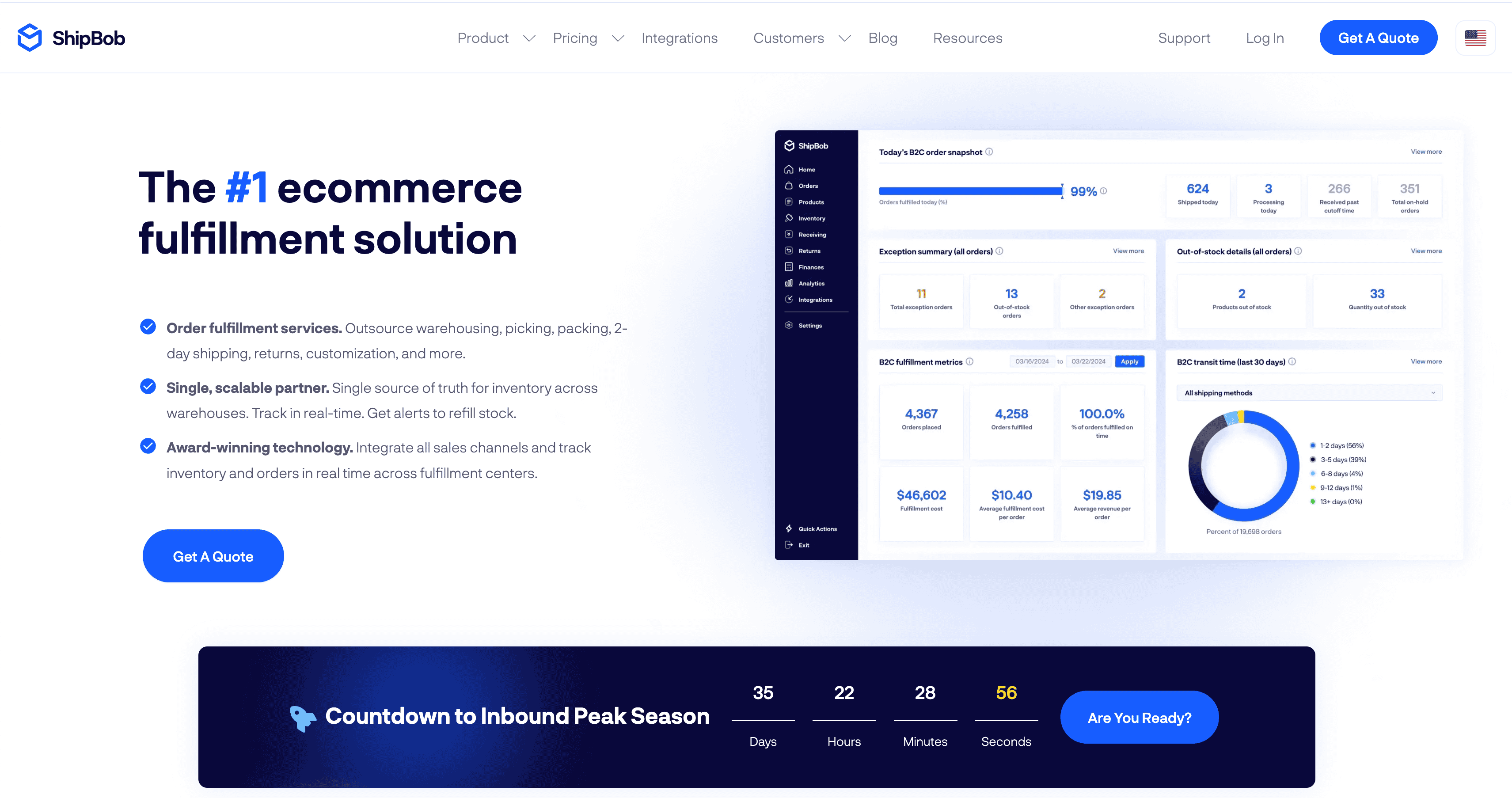
ShipBob’s inventory placement service works like this: you send stock to one regional hub, and ShipBob distributes and rebalances it across its US fulfillment sites based on your order patterns, aiming to put stock closer to customers. That makes inbound consolidation economics part of the evaluation — placement fees, transfer costs, and storage across sites all need to be modeled against your real SKU and destination mix, not estimated.
ShipBob’s durable goods page advertises fulfillment for heavy, large, high-value, and fragile products, plus DTC and retail/B2B support, so don’t rule it out for those categories. But under its shipping rules documentation, heavy and fragile handling are special setup requirements rather than automatic standard inclusion.
Fit decision: request written SKU acceptance and packaging rules for your heaviest and most fragile items before signing. Pricing is quote-based.
Sources: Inventory placement service, durable goods page, shipping rules documentation.
ShipMonk
Best for: subscription boxes, crowdfunding fulfillment, and kitting-heavy operations.
ShipMonk’s strength is batch fulfillment. Its pricing page explicitly supports subscription and crowdfunding batches and kitting. These programs produce near-identical boxes in waves, so batch setup and timing matter. ShipMonk also runs facilities in North America, the UK, and mainland Europe, so confirm which facilities would perform your batch work.
Two commercial details shape the fit. ShipMonk has a monthly minimum calculated from projected monthly volume and the first-item pick fee, so small or seasonal catalogs should work through the math for their expected commitment. And as of September 10, 2026, ShipMonk’s FAQ specified at least 50 identical orders per batch to avoid a smaller-batch setup fee — a fee you’d want to know about before your crowdfunding campaign ends, not after. Fragile-item wrapping is available at an added charge, and platform, onboarding, and add-on technology fees live in the custom quote.
Fit decision: run the monthly minimum against your realistic volume, and price the batch setup fee if a batch has fewer than 50 identical orders.
Sources: Pricing page, covering batch fulfillment, kitting, the monthly minimum calculation, and batch fees.
Amazon FBA
Best for: sellers whose primary channel is the Amazon store.
Fulfillment by Amazon stores your eligible inventory, picks, packs, and ships orders, and handles customer service and returns for FBA orders. Eligible FBA products can offer Prime delivery in the Amazon store, which is what makes FBA worth considering when the Amazon store is your main channel. Amazon publishes a full cost structure across multiple fee categories — fulfillment, storage, inventory aging, returns, removals, and inbound placement — so run their Revenue Calculator against your actual SKUs rather than estimating from memory.
Costs depend heavily on SKU dimensions, weight, and the services used, so large, heavy, or slow-moving products need a modeled cost comparison against alternative fulfillment before you decide.
For cross-channel sellers, keep three things distinct: FBA fulfills your Amazon-store orders; Multi-Channel Fulfillment can fulfill non-Amazon orders from FBA inventory; and Buy with Prime is a separate offering that uses MCF. MCF alone doesn’t confer Prime on external orders. For program-specific fees, see the fee question below — they change and are governed separately from FBA.
Fit decision: compare the Revenue Calculator output for your SKUs, including applicable aging and placement fees, with your alternative fulfillment quotes.
Sources: Fulfillment by Amazon program page, Multi-Channel Fulfillment overview.
LVK
Best for: apparel brands on Shopify, plus broader multichannel DTC and B2B.
LVK is the fulfillment operation formerly known as ShipHero Fulfillment, closely tied to the ShipHero WMS software platform (the software company and the fulfillment operation are now separate entities). It markets apparel fulfillment prominently, along with CPG, electronics, and both DTC and B2B channels, and documents direct Shopify and platform integration. For apparel brands already on Shopify, that combination is a concrete reason to evaluate LVK.
For apparel and footwear sellers, receiving deserves a close look. LVK’s receiving documentation (updated August 17, 2026) states that apparel counting and verification can incur per-unit or hourly charges, and that noncompliant inbound shipments take longer and cost more. Include those receiving requirements and charges in your cost comparison.
Fit decision: confirm what counts as a compliant inbound, what receiving charges look like at your unit volumes, whether special garment handling is available, and what support coverage you get after go-live.
Sources: LVK company page, ShipHero about-us page, store connection guide, receiving overview.
Renewal Logistics
Best for: apparel returns processing, restoration, and retail prep.
Renewal’s apparel services cover custom packaging, labeling and ticketing, kitting, retail prep, pressing, and refolding, plus refurbishment and repackaging. Its returns services handle returns sorting and first-quality resale disposition, including cleaning, steaming, stain treatment, deodorizing, refolding, and rebagging. For brands whose economics depend on recovering value from returned apparel, that scope is distinctive. Renewal also offers ecommerce, retail, and wholesale fulfillment.
Renewal lists Georgia and California locations. The open question is site-level: the public pages don’t fully resolve which service runs at which location, so a mixed requirement like retail prep plus DTC shipping needs confirmation that one site can handle both, or a plan spanning sites.
Fit decision: ask for a sample assessment of your actual returned products and the proposed processing fees before you estimate how much inventory can return to sale.
Sources: Apparel services page, returns and circularity services page.
DCL Logistics
Best for: complex product handling across DTC and retail, including electronics.
DCL’s capabilities page reads like a list of fulfillment’s hard parts: serialization, kitting, light assembly, custom packaging, and firmware updating, alongside DTC/ecommerce, retail, B2B, and Amazon channels. Served sectors include electronics and hardware, CPG, and sports and fitness, among others. That profile fits brands selling products that need more than a poly bag and a label — devices that need firmware flashed, or serialized units that need traceability across channels.
DCL’s platform, eFactory, provides order, inventory, and returns visibility with dedicated service teams. DCL states it holds ISO 9001 certification, which speaks to quality management systems, not product regulatory approval. Buyers in beauty, wellness, or medical devices should verify the specific controls their category requires.
Fit decision: ask which serialization and assembly work happens in-house versus subcontracted, how retail compliance (routing, labeling, chargeback risk) is handled, and what the dedicated-team model means for your account size.
Sources: Capabilities page, company platform page.
Buske Logistics
Best for: brands combining warehousing and distribution with ecommerce/DTC fulfillment.
Buske combines contract warehousing and distribution with ecommerce fulfillment. Its ecommerce pages document DTC pick and pack, marketplace fulfillment, B2B and wholesale, returns, and kitting with custom packaging, plus platform integrations and reporting. Its broader services cover contract warehousing, sequencing, value-added work, and B2B/B2C operations, with industrial, automotive, and food and beverage contexts.
That mix suits brands whose volume includes wholesale or retail distribution alongside DTC orders, or whose products need nonstandard storage and handling between order waves.
Fit decision: have Buske demonstrate how the proposed facilities would handle your DTC orders, distribution and returns together, including staffing for each workflow.
Sources: Ecommerce services page.
Saddle Creek Logistics
Best for: integrated omnichannel warehousing, fulfillment, and transportation.
Saddle Creek offers warehousing, fulfillment, and transportation, separately or as an integrated package across a nationwide US network. That integration matters for omnichannel sellers juggling DTC orders, wholesale replenishment, and retail store distribution: a coordinated proposal can reduce the number of service handoffs you manage. Clients span manufacturing, retail, and ecommerce.
The proposal should identify who operates each transport leg, who resolves exceptions between services, and any volume commitments.
Fit decision: check that your lanes and required sites align with the proposed network, including which services each location can perform.
Sources: Saddle Creek’s provider-authored LinkedIn company profile.
Speed Commerce
Best for: personalization, kitting, and value-added order work.
Speed Commerce’s distinguishing offer is custom services: personalization including embroidery, engraving, etching and embossing, complex kitting and assembly, packaging, inserts, gift wrap, and refreshing returned goods. If your product needs a monogram, an engraved message, or an assembled multi-item kit per order, that capability set is the reason to talk to them. Its core fulfillment services cover receiving, pick and pack, shipping, inventory, and returns, with account services.
Speed Commerce also offers Deposco-powered inventory and order dashboards with reporting. Speed Commerce also offers contact-center services. Confirm which services your proposal includes and how they are priced.
Fit decision: ask how personalization affects order cutoff times and peak-season capacity, what per-order customization fees look like, and whether returns refreshing is priced per unit or per batch. Bring your actual SKU profile so the proposal covers handling as well as customization.
Sources: Custom services page.
How to choose the best 3PL company for your business
The providers above differ enough that the fastest way to a decision is a disciplined quote process. Shortlist two or three based on catalog and channel fit, then make them compete on the same inputs. Here’s what to prepare before you request a quote from anyone, including us:
Your catalog and order profile
| Input to prepare | Why the 3PL needs it |
|---|---|
| Monthly order volume, plus peak-season volume | Sizes labor planning and exposes peak surcharges and minimums |
| Active SKU count | Drives storage configuration, bin logic, and inventory management complexity |
| Units per order and order mix (single-item vs. multi-item, subscription vs. one-off) | Changes pick fees and kitting requirements materially |
| Packaged SKU dimensions and weights | Drives storage class, pick fees, and whether special handling applies |
| Channel mix (DTC, Amazon, retail, wholesale) and sales platforms (Shopify, WooCommerce, BigCommerce, Magento) | Confirms channel coverage and integration support |
| Destination map (ZIP-level if possible) | Determines zone-based shipping cost and transit times from each candidate network |
| Inventory turns and returns rate | Sizes storage needs and returns-processing exposure |
| Fragile, high-value, hazmat, or regulated flags | Narrows providers immediately; some can’t or won’t take them |
The quote checklist
Ask every finalist for the same line items so proposals are comparable:
- Receiving fees and inbound requirements
- Storage rates (per pallet, per bin, per cubic foot) and cutoffs
- Pick and pack fees by order and item profile
- Packaging materials and special-handling charges
- Shipping rates and applicable surcharges
- Returns processing fees and disposition options
- Monthly minimums and how they’re calculated
- Onboarding fees and timeline
- Exit terms, including data, inventory removal, and contract wind-down
One more distinction worth insisting on: clarify what “shipped” means in any SLA. Stock readiness at the warehouse, a dispatch cutoff, and actual delivery to the customer are three different things, so ask what event starts and ends each contractual commitment.
On integrations, treat native support versus middleware as a verification question, not a checkbox: ask whether each 3PL connects natively to your specific platforms, what middleware would sit in between if not, who maintains it, and what happens to order flow when it fails.
Which 3PL has the best accuracy rates?
This comparison can’t establish a measured accuracy winner, because it’s based on public documentation, not independent testing of the ten providers.
Two things help you evaluate accuracy claims properly. First, distinguish order accuracy (the right items, in the right quantity, in the right packaging) from inventory accuracy (system counts matching physical counts). Second, when a provider cites a metric, ask for dated reporting with a period and a denominator. A guarantee, an advertised metric, or a missing benchmark is not the same as verified operational performance: a money-back guarantee tells you about the remedy, not the error rate, and an absent figure tells you to ask, not that performance is poor.
Alongside the numbers, get the contractual remedies: what counts as an accuracy error, how it’s measured, what the provider pays or credits when the SLA is missed, and how you’d prove a disputed error. Define when each metric is measured and which evidence supports a claim.
FAQ
What is a 3PL company?
A third-party logistics company handles logistics functions on your behalf, typically warehousing, pick and pack, and shipping, and often returns and value-added services. You keep ownership of the inventory; the 3PL executes the physical work.
How much does a 3PL cost?
There isn’t one price that represents every catalog. Costs can include storage, receiving, pick and pack, packaging, shipping, returns, minimums, and onboarding. Compare providers using identical order data, applying published rates where available and requesting quotes for the remaining services.
When should a business outsource fulfillment?
There’s no universal order-volume threshold. Common triggers: shipping eats more time than product work, storage space runs out, error rates climb, or customers complain about delivery speed. If fulfillment is your bottleneck rather than a routine, outsourcing starts making sense.
What’s the difference between a 3PL and a fulfillment center?
They overlap but aren’t identical. A fulfillment center is a facility that stores and ships orders. A 3PL is a company providing logistics services, which can include fulfillment, transportation, returns, or other work. Some operate fulfillment centers; others focus on services such as transportation. Ownership of a warehouse isn’t what defines a 3PL.
Is the biggest 3PL the best choice?
Size alone doesn’t establish fit. Compare catalog handling, channel coverage, service commitments, and the locations that would actually serve your customers. A large network is useful only if the proposed sites, capacity, and commercial terms match your business.
Are Reddit threads and reviews reliable for choosing a 3PL?
Use them to identify questions about billing, support, returns, and offboarding. Check the review date, the merchant’s product type, volume, and service location. Then ask finalists for relevant customer references and written commitments. A forum post can’t establish how a provider will perform for your account.
Can 3PLs handle heavy or oversized products?
Red Stag specializes in big and heavy fulfillment, and ShipBob also advertises heavy and fragile durable-goods support. Compare packaging requirements, storage, handling fees, and shipping costs for your actual products. Confirm SKU acceptance in writing; an advertised capability doesn’t establish the economics of your catalog.
Did Amazon change fuel or logistics fees in 2026?
Amazon’s fee structures are program-specific. Multi-Channel Fulfillment’s current rate card (dated June 1, 2026) includes a US MCF surcharge, while FBA fees are governed by separate announcements. Check the applicable program, region, and effective date before applying a surcharge to your cost model.
Which 3PL is best for high-value products?
Look for providers that explicitly address loss and damage liability, not just storage. Ask what happens financially when an expensive unit is lost, damaged, or mispicked. Red Stag’s policy reimburses the client’s cost for lost or damaged items. Compare that with each candidate’s written liability terms, claim requirements, and proposed handling controls.
What about small businesses and startups?
Start with fit and minimums rather than brand names. Confirm monthly minimums, setup costs, storage commitments, and exit terms early. ShipMonk’s subscription and crowdfunding services can be relevant for batch businesses, but its monthly minimum still needs to fit your volume. Compare outsourcing with the full cost and capacity of your current operation.
Get a quote scoped to your catalog
If heavy, bulky, fragile, or high-value products are what you sell, contact Red Stag Fulfillment to request a fulfillment quote. To make the quote useful, have ready: your packaged SKU dimensions and weights, monthly and peak order volumes, active SKU count, units per order, channel mix, destination spread, and your returns profile. Ask for an itemized proposal so you can compare line items with the other providers on your shortlist.

