The best fulfillment companies in the USA for 2026 are Red Stag Fulfillment (heavy, bulky, and high-value items), eFulfillment Service (no-minimum startups and small businesses), ShipBob (small-to-mid-sized DTC brands), and Fulfillment by Amazon (Amazon-native sellers). These rose to the top among the ecommerce fulfillment companies we compared across accuracy rates, warehouse coverage, platform integration, and pricing transparency.
Finding the right ecommerce fulfillment partner matters because a 1% pick error rate on 10,000 monthly orders means 100 wrong shipments, each costing $15–$25 in returns processing, customer support time, and lost revenue from buyers who never come back. The order fulfillment companies below range from startup-friendly services with zero order minimums to enterprise logistics operations handling 50,000+ shipments per month. This guide helps you match your product type, monthly volume, and growth goals to the fulfillment company built for your business.
We examined each provider’s specialties and limitations, minimum requirements, order accuracy rates, warehouse locations, technology capabilities and ecommerce platform integrations, and pricing structures, so you can narrow your list of the best fulfillment companies before requesting quotes.
Best fulfillment companies in the USA: quick comparison
| Service | Best For | Accuracy | Min. Orders | US Warehouses | Standout Differentiator |
|---|---|---|---|---|---|
| Red Stag Fulfillment | Heavy, bulky, high-value items over 5 lbs | Financially backed: zero shrink, zero mispicks, zero late shipments | 200+/month | 2 (reaches 96% of US in 2 days) | Only fulfillment company offering financial guarantees on accuracy, timeliness, and zero shrinkage |
| eFulfillment Service | New sellers and small businesses | 99.9% | None | 2 | No minimums, no long-term contracts, and the lowest barrier to entry for startups |
| Fulfillment by Amazon (FBA) | Amazon-native sellers | Undisclosed | None | 175+ | Prime badge eligibility with unmatched delivery speed for Amazon orders |
| ShipBob | Small to mid-sized DTC brands | 99.95% | Monthly minimum applies | 40+ (ShipBob operates 5; the rest are partner 3PLs) | Strongest international presence with deep Shopify and ecommerce platform integration |
| ShipMonk | Subscription box brands and DTC startups | 99.9% | Monthly minimum applies | 8 | Specialized subscription box kitting and management services |
| We Ship Express | Alcohol beverage brands (wine, beer, spirits) | Not disclosed | Custom pricing | 2 | 20+ years of state-by-state alcohol compliance and hazmat-certified facilities |
| Buske Logistics | Large-scale warehousing and FBA prep | 99.5%+ | None | 37 (US & Canada) | 7.5M+ sq ft of warehouse space with ISO 9001/FDA certifications and Pay-on-Use pricing |
| Speed Commerce | Small to medium ecommerce with value-added services | Not disclosed | None | 2 | Embroidery, engraving, assembly capabilities with 24/7 customer support |
| Shiptquick | Apparel and footwear brands | Not disclosed | Custom pricing | 1 | Founded by DTC fashion brand owners with high-SKU and returns expertise |
| Ottawa Logistics | Canadian fulfillment and cross-border shipping | Not disclosed | 500–1,000/month | 3 (US & Canada) | Canadian market specialist since 1986 with bilingual support and Health Canada/FDA compliance |
How to compare the best fulfillment companies
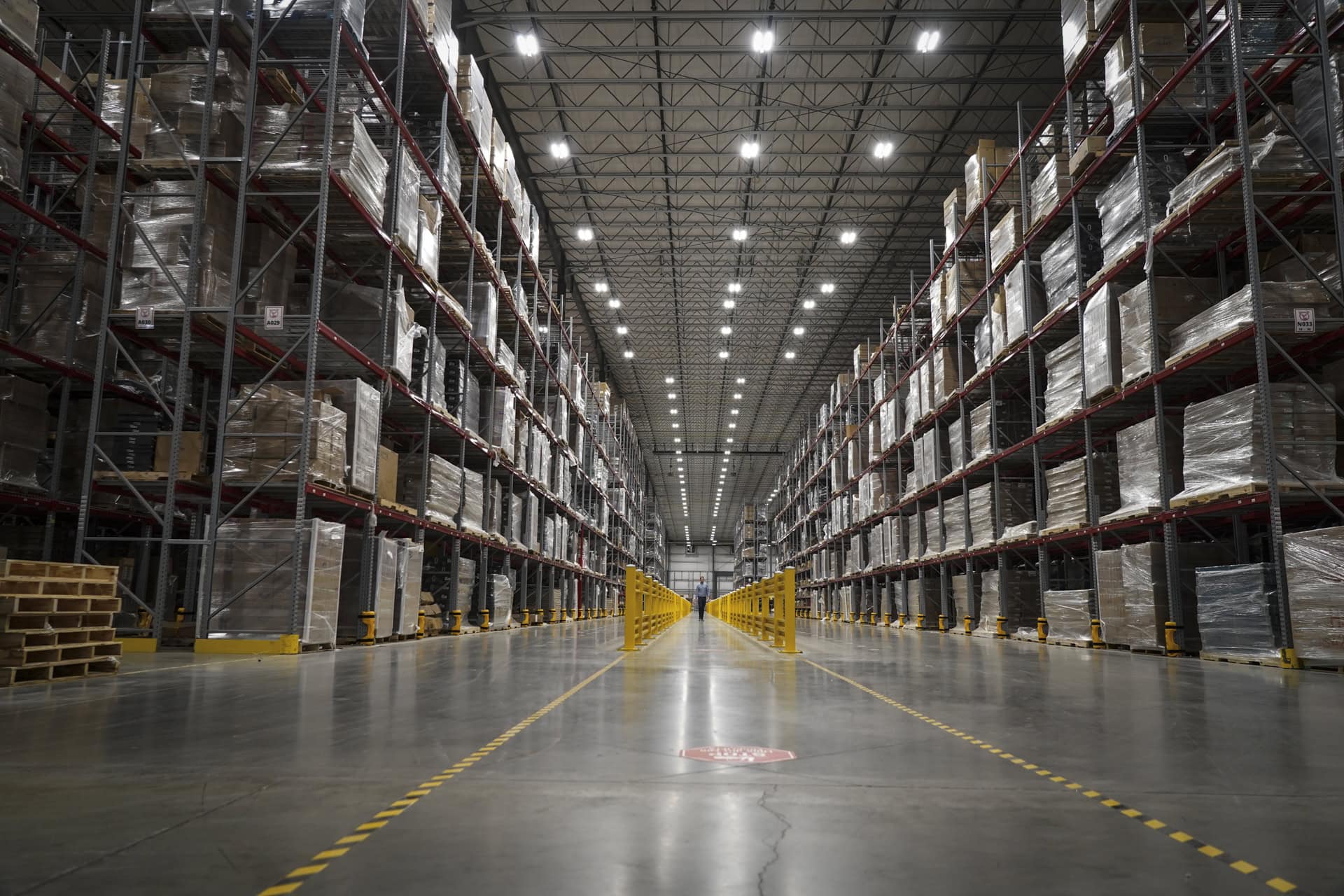
Comparing ecommerce fulfillment companies starts with three questions that eliminate most poor-fit providers: What do your products weigh? How many orders do you ship monthly? And which sales channels and ecommerce platforms (Shopify, Amazon, WooCommerce, BigCommerce, Etsy) need to integrate with your fulfillment partner’s software?
These aren’t abstract considerations. A DTC brand shipping 500 lightweight orders per month through Shopify has fundamentally different fulfillment needs than a brand shipping 200 heavy, oversized items through Amazon and its own online store. The wrong fulfillment service provider costs you in re-shipping fees, customer satisfaction losses, and the operational pain of switching providers mid-growth.
Start by assessing your current operations and business goals across these key factors:
What are your short- and long-term growth goals, and how fast do you expect order volume to scale?
Do you need international shipping capabilities or cross-border fulfillment for markets outside the US?
Are you preparing for peak seasons, product launches, or increased demand that requires flexible logistics infrastructure?
Do you need special services like kitting, custom branded packaging, returns management, temperature-controlled storage, or FBA prep?
Which ecommerce platforms and sales channels (Shopify, Amazon, WooCommerce, BigCommerce, eBay, Etsy, Walmart) does your online store sell through?
Then compare your shortlisted providers across these metrics. Each is covered in detail below:
Parcel weight limits and product handling capabilities
Monthly order minimums and pricing structure
Order accuracy rates and service quality guarantees
Fulfillment center locations and delivery speed coverage
SKU breadth requirements and ecommerce platform integrations
Parcel weight limits
How large and heavy are your products?
Roughly 80% of ecommerce packages weigh under 10 pounds, which means most fulfillment companies optimize their entire fulfillment process (warehouse layout, packing stations, carrier contracts) for lightweight parcels. If your products weigh more than 10 pounds, require temperature-controlled storage, or need custom packaging, you need a fulfillment service provider with logistics infrastructure designed for those requirements.
The cost difference is significant: shipping a 30-pound item through a provider equipped for 2-pound packages often means incorrect dimensional weight pricing, higher damage rates during order processing, and slower turnaround because the warehouse staff isn’t trained for heavy item handling. Ask any prospective fulfillment partner what percentage of their shipments exceed 10 pounds. If the answer is under 5%, your products will be an exception they accommodate, not a specialty they excel at.
Order minimums
How many packages do you ship each month?
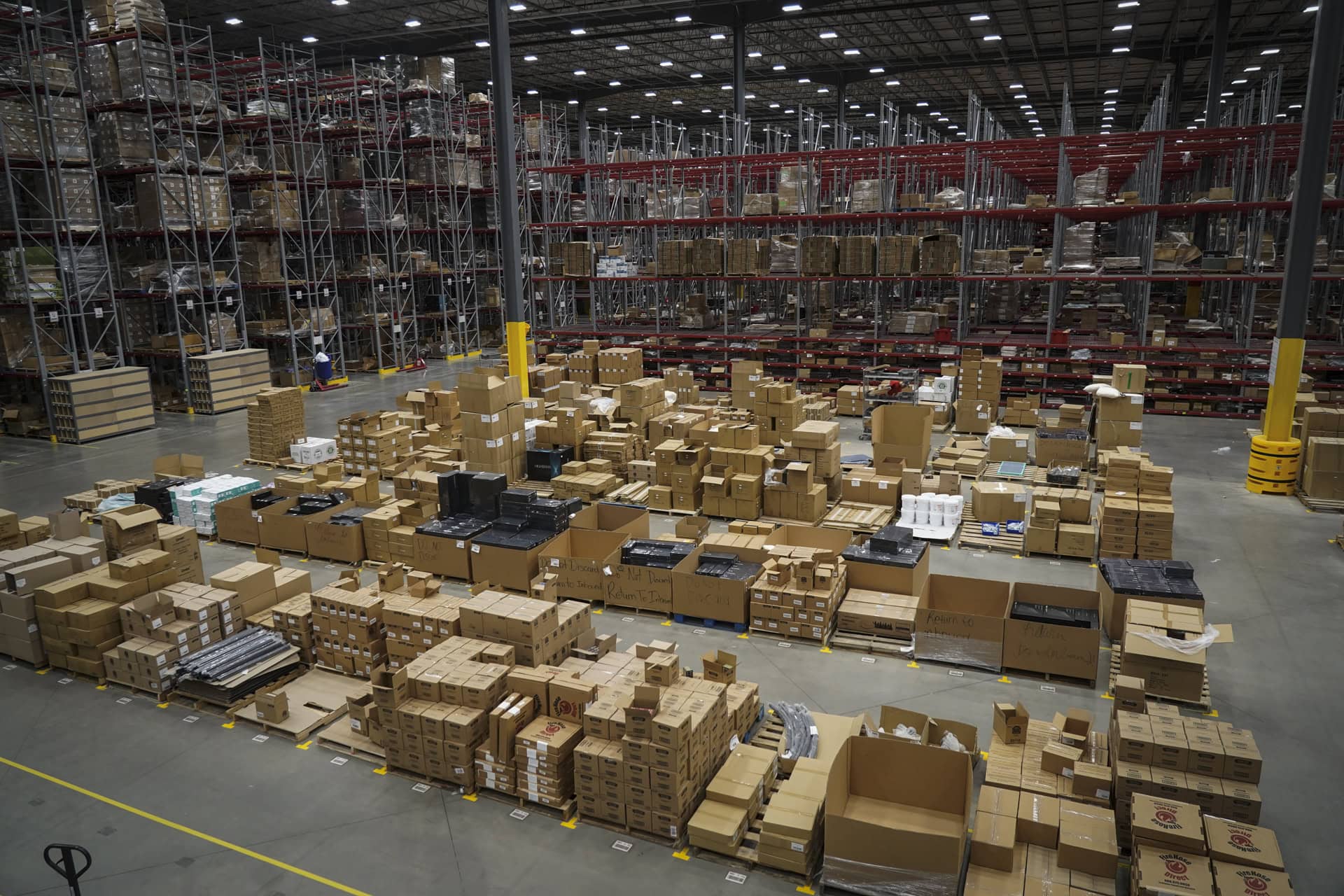
Order minimums tell you what kind of brand a fulfillment company is built to serve. A provider requiring 1,000+ orders per month has invested in automation, conveyor systems, and bulk carrier contracts that keep per-order costs low at scale, but that logistics infrastructure isn’t cost-effective for brands shipping 200 orders monthly. Conversely, providers with no minimums (like eFulfillment Service) offer flexibility for small businesses and startups, but may lack the throughput capacity growing brands eventually require.
If you’re scaling rapidly, look for a fulfillment center that serves your current volume without penalizing growth. Some fulfillment service providers lock in pricing tiers that increase per-order cost as you grow, the opposite of what your brand needs. Ask for a pricing schedule that shows cost-per-order at 500, 2,000, and 10,000 monthly shipments so you can model how fulfillment costs change as your business scales.
Order accuracy rates
How often does the 3PL ship the correct products?
Order accuracy is the single most important metric when evaluating fulfillment companies, because every mispick triggers a cascade of costs: the wrong item ships ($5–8 in wasted packaging and postage), the customer contacts support ($8–12 in service cost), a return ships back ($7–15 in reverse logistics), and the correct item re-ships ($5–8 again). A single error easily costs $25–40 and directly harms customer satisfaction and repeat purchase rates.
A 4% error rate on 5,000 monthly orders means 200 mistakes costing $5,000–$8,000 per month in lost revenue and rework. The best fulfillment companies in this guide maintain strong accuracy rates, with Red Stag Fulfillment backing its accuracy with a zero mispicks guarantee. When evaluating any fulfillment service provider, ask for documented order accuracy data over the past 12 months, not just a claim on their website. Any provider unwilling to share real accuracy numbers is a red flag.
Warehouse locations and delivery speed
Top ecommerce fulfillment centers are strategically located for fast delivery
Fulfillment center locations directly control delivery speed and shipping costs for your customers. A strategically located warehouse within one or two shipping zones of your customer base can cut transit times from 5 days to 2 and reduce shipping costs by 15–25% compared to shipping cross-country. For most US-based ecommerce brands, two strategically located warehouses, one in the eastern US and one in the western US, provide timely delivery via 2-day ground to 90–96% of the population.
Costs and complexity of multiple warehouse locations
Distributing inventory across many fulfillment centers accelerates fast delivery but adds complexity: you’ll pay inbound freight to each location, need tighter inventory management and inventory forecasting to avoid stockouts at individual warehouses, and require a fulfillment partner whose software provides real-time visibility across all locations. The outbound savings typically offset these costs for brands shipping from multiple fulfillment warehouses at 1,000+ orders per month, but smaller operations often perform better consolidating in a single strategically located facility to keep logistics simple and costs predictable.
SKU breadth requirements
How many unique SKUs do you sell?
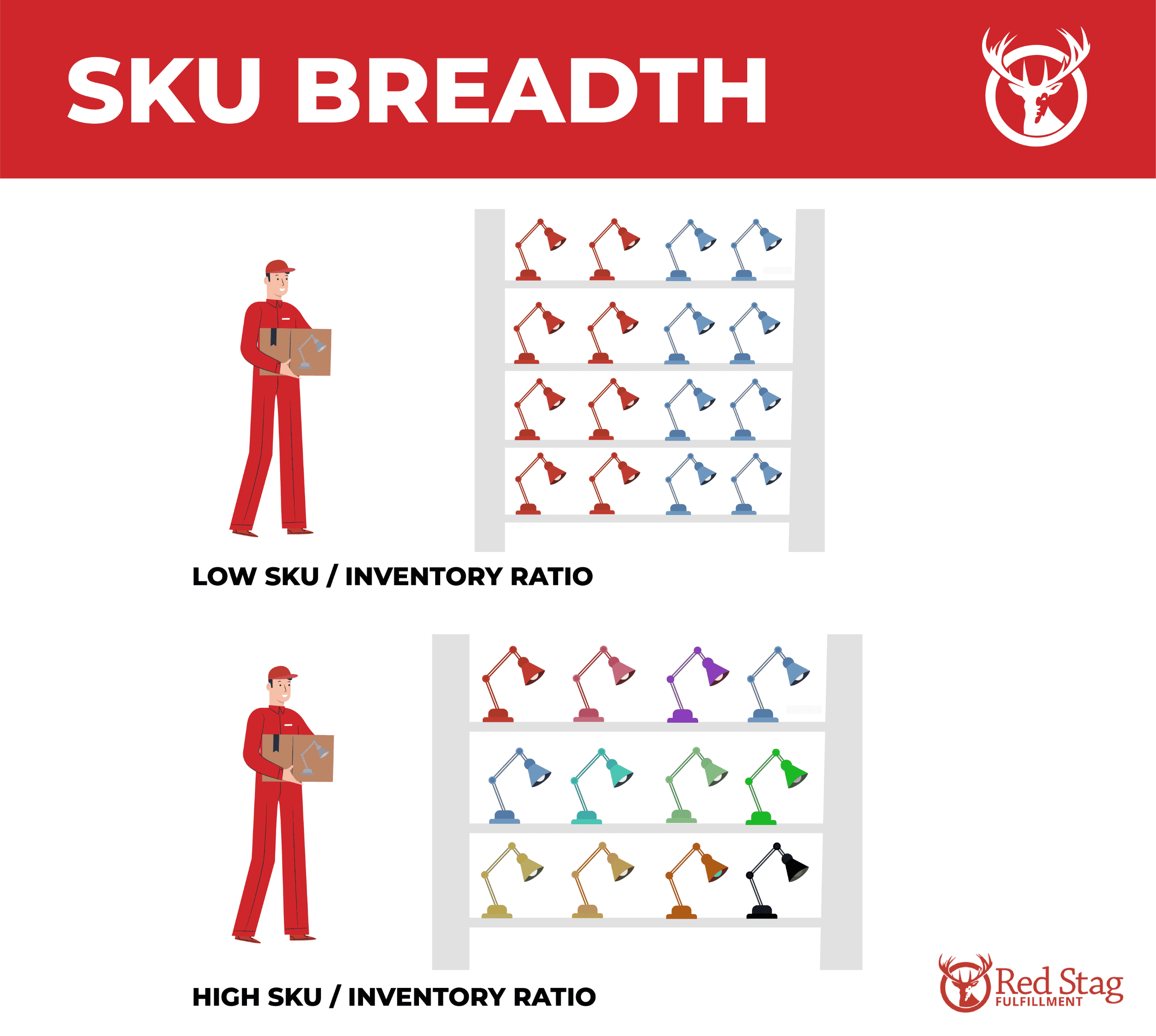
SKU breadth is the ratio of how many different items you sell to the number of customer orders you ship each month. Some fulfillment services have a minimum SKU-to-order ratio. For example, if you sell 100 different SKUs, a 5:1 SKU breadth ratio would require you to ship at least 500 customer orders each month. You don’t need to ship five from each SKU, just 500 orders overall.
Even if an order fulfillment company doesn’t enforce a strict SKU breadth requirement, the best ecommerce fulfillment companies will want to understand your catalog size to optimize warehouse slotting, pick paths, and inventory control. Brands with high SKU counts across multiple product types (like apparel with many sizes and colors) should look for a 3PL provider with a warehouse management system (WMS) designed to handle that complexity without increasing pick errors.
Other considerations when choosing the best fulfillment company
Products, order minimums, and warehouse locations are the foundation of your 3PL decision, but service quality, technology, and support capabilities separate a reliable partner from one that creates more problems than it solves. Use this fulfillment company questionnaire to structure the questions you ask when interviewing a potential ecommerce fulfillment provider. Modify it to fit your brand’s specific needs and values. The more thorough you are now, the fewer surprises you’ll encounter after onboarding.
What questions should you ask a fulfillment company?
How do you handle returns management and reverse logistics?
Returns management is either a profit center or a cost drain depending on how your 3PL handles the entire fulfillment process in reverse. Ask specifically: What’s the average processing time from return receipt to restocking? Do they inspect returned items for resale eligibility? Can they process exchanges and ship a replacement before the return arrives? For ecommerce brands selling apparel, returns rates of 20–30% mean your reverse logistics capability directly impacts your bottom line. A fulfillment company that simply receives returns and warehouses them isn’t providing real returns management. Look for providers that offer quality control inspection, repackaging, and real-time inventory updates when items re-enter stock.
What shipping carriers and delivery services do your fulfillment centers use?
Relying on a single shipping carrier is a risk, especially during peak seasons when capacity constraints can delay timely delivery by days. The best fulfillment companies maintain established relationships with various shipping companies, including regional carriers beyond UPS, FedEx, and USPS, and they use rate-shopping software with carrier integration to automatically select the fastest, most cost-effective option for each shipment based on destination, package dimensions, and delivery speed requirements. Ask how many carriers the provider works with and whether their system optimizes carrier selection automatically or relies on manual processes.
Do you offer subscription boxes, kitting, and custom branded packaging?
If your brand offers customized packages, subscription boxes, or product bundles, choose a 3PL that provides kitting services to assemble your orders, because not every third-party logistics company offers this. Branded packaging and custom inserts create a better unboxing experience for your customers, but they add complexity to the fulfillment process. Ask about per-kit assembly fees, minimum order requirements for custom packaging runs, and whether the provider can handle variable kitting (different items in each box) or only fixed bundles.
What sales channels, ecommerce platform integrations, and order management tools do you support?
The best fulfillment service providers offer native integrations with popular ecommerce platforms (Shopify, WooCommerce, BigCommerce, Amazon, eBay, Etsy, and Walmart Marketplace), plus order management systems that sync inventory across every sales channel in real time. Ask whether the integration is native (built and maintained by the fulfillment company) or relies on third-party middleware like ShipStation, which adds a point of failure and an additional monthly cost. Your ecommerce fulfillment software should also provide analytics dashboards showing fulfillment speed, shipping cost per order by zone, and return rates by SKU, not just basic inventory counts.
What level of customer support and account management do you provide?
Customer support quality varies wildly among the best fulfillment companies. Some provide a dedicated account manager with a direct phone line, integrated ticket tracking, and a 4-hour response time SLA. Others route you through a support queue where responses take 24–48 hours. Determine what level of support your brand needs. If you’re running promotions, launching new products, or managing complex inventory across multiple facilities, slow support response times can cost you thousands in delayed shipments and unmet customer expectations. Ask about response time guarantees, whether you’ll have a named point of contact, and how the provider handles urgent support issues outside of standard business hours.
How much do fulfillment services cost, and are there hidden fees?
When you talk to a 3PL about storage fees, fulfillment costs, and shipping rates, make sure to get the full picture including setup fees, monthly minimums, and any surcharges for peak seasons or special handling. The best fulfillment companies provide transparent pricing with no hidden fees so you can forecast landed costs and total supply chain spend accurately. Ask for a complete fee schedule that includes receiving, storage (per cubic foot or per pallet), pick-and-pack, packaging materials, shipping, returns processing, and any technology integration fees. It’s tempting to choose the least expensive option, but the cheapest fulfillment provider isn’t always the best. Balance cost considerations with service quality, customer support, reliability, and the delivery experience your brand requires.
The 10 best fulfillment companies in the USA (2026)
With these considerations in mind, here are our recommendations for the best ecommerce fulfillment companies of 2026. Many fulfillment companies make similar promises, so we focused on documented accuracy rates, transparent pricing, technology compatibility, and the specific types of brands each provider serves best. Use the detailed comparison table below to evaluate providers side by side, then read each provider’s profile for a closer look at their services, warehouse locations, and ideal customer profile.
| Service | Weight Limit | Order Minimum | Accuracy | US Warehouses | SKU Requirements |
|---|---|---|---|---|---|
| Red Stag Fulfillment | None | 200+ | Financially backed: zero shrink, zero mispicks, zero late shipments | 2 | Case-by-case basis |
| eFulfillment Service | 50 lbs | None | 99.9% | 2 | None |
| FBA | 50 lbs | None | Undisclosed | 175+ | Undisclosed |
| ShipBob | 50 lbs | $275/month min. | 99.95% | 40+ | <5k SKUs: 4:1 ratio >5k SKUs: 5:1 ratio |
| ShipMonk | 50 lbs | $250/month min. | 99.9% | 8 | 2:1 |
| We Ship Express | 150 lbs | Custom pricing | Not disclosed | 2 | Undisclosed |
| Buske Logistics | Standard + heavy/oversized | None | 99.5%+ | 37 | Undisclosed |
| Speed Commerce | Not disclosed | None | Not disclosed | 2 | Undisclosed |
| Shiptquick | Not disclosed | Custom pricing | Not disclosed | 1 | Undisclosed |
| Ottawa Logistics | Not disclosed | 500–1,000 | Not disclosed | 3 (US & Canada) | Undisclosed |
Red Stag Fulfillment
Best fulfillment company for: heavy, bulky, and high-value items over 5 lbs

Red Stag Fulfillment specializes in shipping heavy, oversized, and high-value merchandise, a niche that most fulfillment companies avoid because the handling complexity, damage risk, and carrier pricing are significantly harder to manage than standard lightweight parcels. Red Stag is selective about the brands it works with (it accepts less than 5% of businesses that inquire) because that focus is what allows it to be the only fulfillment company in this guide that backs its service quality with financial guarantees:
- Accuracy guarantee.
If an order is shipped with the wrong item or the wrong number of items, Red Stag fixes the mistake, refunds the shipment cost, and credits the client for the inconvenience. - On-time fulfillment guarantee.
Orders ship according to the chosen service level (including same-day fulfillment), or the shipment is free, plus a credit to the client. - Zero-shrinkage guarantee.
If any inventory is damaged or goes missing after Red Stag receives it, the company pays the wholesale cost of that item. No exceptions.
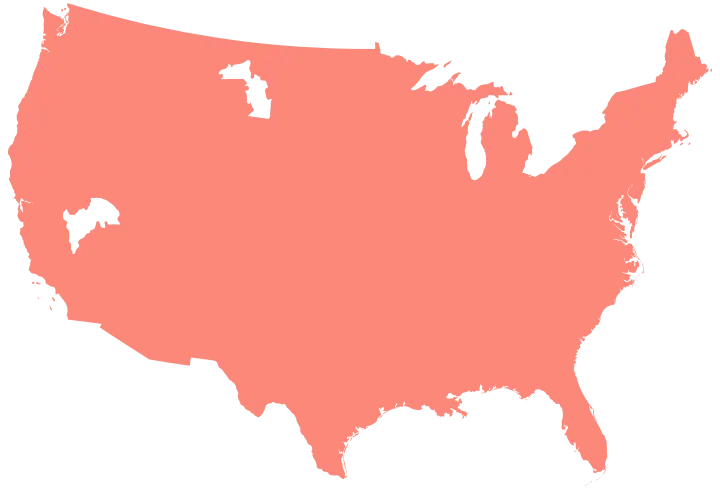
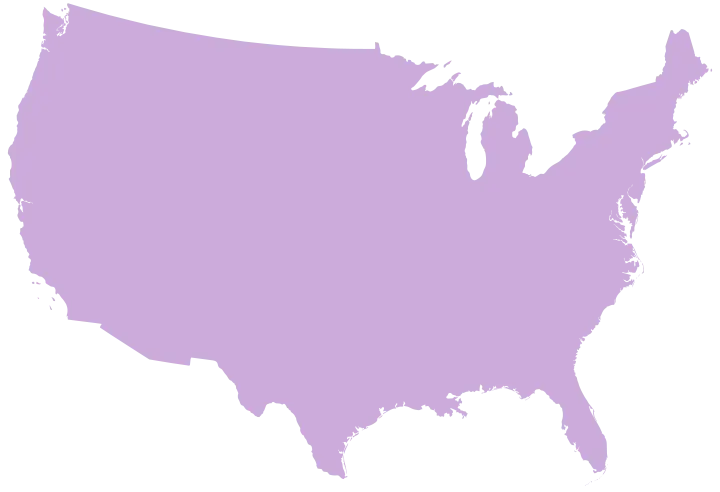
Red Stag works best with brands shipping hundreds to thousands of orders per month, primarily packages weighing five pounds or more, including high-value merchandise and big, bulky products. The company evaluates SKU breadth on a case-by-case basis to build a customized fulfillment plan for each client. With two US fulfillment centers, in Knoxville, Tennessee and Salt Lake City, Utah, Red Stag can deliver to 96% of the US population within two days using ground shipping. Even if Red Stag isn’t the right fit for your brand, the team will have an honest conversation about your fulfillment needs and connect you with a better-suited provider. Reach out to start that conversation.
Red Stag isn’t the right fit for everyone. Apparel- and footwear-only brands, sub-5-lb high-volume DTC, and international-primary operations are usually better served by ShipBob or eFulfillment Service. Heavy, bulky, fragile, and high-value is where Red Stag is the strongest pick, and it’s the only company in this guide that backs accuracy, on-time shipping, and zero shrinkage with financial guarantees.
Parcel weight limit: None
Order minimums: Varies by client (reach out for details)
Error rate: Not published; backed by our zero mispicks guarantee
Our Locations
Select one (or both) of our strategically placed warehouse locations to see our reach.
Red Stag intentionally has only two locations.
See why that could be better for your brand.







eFulfillment Service
Best fulfillment company for: new sellers and small businesses (no minimums)

Located in Traverse City, Michigan, eFulfillment Service is the best fulfillment company for new sellers and small businesses because it has no minimum order requirements, no long-term contracts required, and no SKU breadth restrictions. This makes it the lowest-risk entry point for brands testing third-party fulfillment for the first time. eFulfillment Service limits packages to 36 inches or less and under 50 pounds, so it’s designed for standard-sized ecommerce products rather than heavy or oversized items. The company offers integration with major selling platforms and provides transparent pricing that small businesses can budget around from day one.
Parcel weight limit: 50 lbs
Order minimums: None
Error rate: < 0.01%
Fulfillment by Amazon
Best fulfillment company for: Amazon-first sellers

Fulfillment by Amazon (FBA) provides dedicated order fulfillment, warehousing, and fast delivery services for Amazon sellers who rely on the platform as their primary marketplace. Every FBA order is eligible for Prime, which gives sellers access to Amazon’s massive customer base and the delivery speed expectations online shoppers now take for granted. FBA ships packages up to 50 pounds, but the service is most cost-effective for smaller, lightweight parcels. Amazon fulfillment fees increase significantly for heavy or oversized items.
FBA doesn’t require minimum order volumes, making it accessible to new sellers and small businesses just getting started on Amazon. The tradeoff is reduced operational control: Amazon determines how and where your inventory is stored across its 175+ fulfillment centers, and FBA services fees, including long-term storage charges, can be unpredictable. Brands selling through multiple marketplaces beyond Amazon often pair FBA with a separate fulfillment partner to handle non-Amazon orders, creating a hybrid fulfillment approach that maximizes the Prime badge on Amazon while maintaining full control over DTC and other marketplace channels.
Parcel weight limit: 50 lbs
Order minimums: None
Error rate: Undisclosed
ShipBob
Best fulfillment company for: lightweight DTC at scale and international

ShipBob is an omnichannel ecommerce fulfillment company built for small-to-mid-sized DTC brands shipping lighter products. With 40+ fulfillment centers across the US, Canada, Europe, and Australia, ShipBob offers the strongest international presence and global logistics capabilities of any provider on this list, which makes it a strong choice for brands expanding into cross-border markets. ShipBob’s deep Shopify integration, multi-channel sync across popular ecommerce platforms, and analytics dashboards give growing brands real-time visibility into inventory levels, fulfillment speed, and delivery performance with responsive customer support.
While ShipBob doesn’t have traditional order minimums, it does charge a minimum fulfillment fee of $275 per month and works best with packages under 50 pounds. ShipBob also enforces SKU breadth requirements: sellers with fewer than 5,000 SKUs need a 4:1 monthly order-to-SKU ratio, while those with more than 5,000 SKUs need a 5:1 ratio. This means ShipBob is better suited for brands with focused product catalogs and consistent demand rather than businesses with expansive, slow-moving SKU counts.
Parcel weight limit: 50 lbs
Order minimums: $275/month minimum charge
Error rate: 0.05%
ShipMonk
Best fulfillment company for: subscription boxes and startups

ShipMonk is a startup-friendly ecommerce fulfillment company well-suited for brands shipping subscription boxes and recurring-order products. With eight fulfillment center locations across the country, ShipMonk provides broad geographic coverage for fast delivery to most US customers. The company allows parcels up to 50 pounds but is best for shipping small packages and lightweight goods. ShipMonk enforces a 2:1 monthly shipment-to-SKU ratio and charges a minimum pick-and-pack fee of $250 per month rather than a traditional order minimum.
ShipMonk’s platform offers direct integration with Shopify, Amazon, WooCommerce, and other popular storefronts, and its order management tools give growing DTC brands real-time inventory tracking and customer support visibility. For subscription box businesses specifically, ShipMonk’s kitting capabilities and recurring order automation make the entire fulfillment process smoother than working with a generic provider that treats subscription orders as an afterthought.
Parcel weight limit: 50 lbs
Order minimums: $250/month minimum fee
Error rate: 0.1%
We Ship Express
Best fulfillment company for: alcohol brands (wine, beer, spirits)
Located in Napa, California with a major 200,000 sq ft hazmat-certified facility in St. Charles, Missouri, We Ship Express is the best fulfillment company for alcohol beverage brands because it specializes exclusively in wine, beer, and spirits logistics. With over 20 years navigating complex state-by-state alcohol regulations, it’s the go-to fulfillment partner for wineries, breweries, and distilleries needing compliant direct-to-consumer delivery services.
We Ship Express operates through temperature-controlled fulfillment centers with a 25-point quality control inspection process and specialized routing software that optimizes carrier selection based on alcohol regulations across 40+ connected shipping companies. They integrate with Commerce7, Shopify, and ShipStation, and provide comprehensive services including mandatory adult signature verification, ice pack insertion during warm months, and state-by-state compliance management. These are services that generic fulfillment companies simply cannot provide for regulated products.
Parcel weight limit: 150 lbs
Order minimums: Custom pricing, no public minimums
Error rate: Not disclosed
Buske Logistics
Best fulfillment company for: B2B and large-scale warehousing
Headquartered in Edwardsville, Illinois, Buske Logistics operates 37 fulfillment centers across the US and Canada with over 7.5 million square feet of warehouse space, the largest logistics infrastructure footprint on this list. Buske Logistics is best for brands needing extensive warehousing combined with comprehensive FBA prep services and retail compliance capabilities. This 102-year-old fulfillment company serves Fortune 500 clients while maintaining flexible solutions for smaller ecommerce brands and growing DTC businesses.
Buske Logistics offers transparent, volume-based pricing with no minimum fees through their “Pay-on-Use” model, making them accessible to small businesses shipping as few as 1,000 orders monthly while also supporting enterprise clients storing 1,500+ pallets. Their FBA prep capabilities include FNSKU labeling, multi-SKU bundling, and complete retail compliance for Amazon, Walmart, and Target fulfillment requirements. With ISO 9001 and FDA certifications, Buske Logistics provides 24/7 operations, reliable integration with major marketplace platforms, and the kind of established supply chain relationships that ensure consistent service quality even during peak seasons.
Parcel weight limit: Standard parcel plus heavy/oversized freight forwarding capabilities
Order minimums: None
Reported accuracy: 99.5%+
Speed Commerce
Best fulfillment company for: fulfillment plus in-house customer service
Operating from Las Vegas, Nevada with a main fulfillment center in Louisiana, Missouri, Speed Commerce is best for small to medium-sized ecommerce businesses and growing startups because it eliminates typical onboarding barriers through transparent pricing with no hidden setup fees, straightforward integration with popular selling platforms, and scalable fulfillment solutions. Since 1983, they’ve operated over 500,000 square feet of warehouse space with a 250-seat contact center providing 24/7 customer support, an unusually high level of service for a fulfillment company serving smaller brands.
Speed Commerce distinguishes itself through extensive value-added services including embroidery, engraving, wood and glass cutting, and complex product assembly, capabilities rarely offered to small-volume shippers by most fulfillment companies. Their domestic US focus optimizes shipping zones to reduce shipping costs, while same-day fulfillment capabilities and volume-based discounts that decrease cost per order as your brand grows make Speed Commerce attractive for businesses that need a reliable partner who can scale with them through multiple stages of sales growth.
Parcel weight limit: Not disclosed
Order minimums: None
Error rate: Not disclosed
Shiptquick
Best fulfillment company for: apparel and footwear
Based in Kentland, Indiana, Shiptquick operates a 120,000 square foot Midwest fulfillment center and is the best fulfillment company for apparel and footwear brands because it’s founded by active DTC fashion brand owners who understand the challenges of managing inventory across multiple sizes, colors, and styles. Their centralized location provides efficient shipping to reach most US destinations cost-effectively, and their focus on fashion logistics means they understand the customer experience expectations that fashion shoppers bring to every order.
Shiptquick specializes in managing high SKU counts with real-time inventory tracking and climate-controlled storage essential for fashion preservation. They offer comprehensive returns management with detailed analysis of return reasons, a critical capability for fashion brands where fit issues drive return rates of 20–30%. Integration with Shopify, Amazon, and other major platforms, combined with custom packaging capabilities, positions Shiptquick as a personalized 3PL alternative for apparel sellers who need more support and attention than larger providers typically offer.
Parcel weight limit: Not disclosed
Order minimums: Custom pricing, no public minimums
Error rate: Not disclosed
Ottawa Logistics
Best fulfillment company for: Canadian and cross-border fulfillment
Headquartered in Ottawa, Ontario with over 250,000 square feet of warehouse space and additional facilities in New York and Texas, Ottawa Logistics is the best fulfillment company for Canadian fulfillment and cross-border shipping because it has specialized in Canadian market logistics since 1986. Strategically positioned between Toronto and Montreal, they offer comprehensive Canadian market access with bilingual support staff and deep expertise in Health Canada and FDA regulations, which is essential for brands shipping products that require regulatory compliance across international borders.
Ottawa Logistics typically works with businesses processing 500–1,000 orders monthly with no long-term contracts required. Same-day shipping for orders received before 1:30 PM, combined with partnerships with Canada Post, FedEx, and UPS, ensures efficient delivery services across Canada. For US-based ecommerce brands looking to expand into the Canadian market without navigating cross-border fulfillment complexity themselves, Ottawa Logistics provides a reliable partner with the established carrier relationships, platform integration capabilities, and regulatory knowledge to handle international shipping smoothly.
Parcel weight limit: Not disclosed
Order minimums: Typically 500–1,000 orders/month
Error rate: Not disclosed
Best fulfillment companies for small businesses
Small businesses and startups have fundamentally different fulfillment needs than enterprise brands: lower order volumes, tighter budgets, and less tolerance for hidden fees or long-term contracts. Several of the fulfillment companies in this guide serve small businesses well (eFulfillment Service, ShipMonk, and Speed Commerce all offer low or no minimums), but choosing the right fulfillment partner for a growing small business requires evaluating factors beyond what this comparison covers. We built a dedicated guide that ranks the best 3PLs for small businesses, including detailed pricing breakdowns, onboarding ease, and which providers scale most cost-effectively as your brand grows from 100 to 5,000+ orders per month.
Looking for a US or American fulfillment company?
All ten providers here operate U.S. warehouses, which matters more than it sounds. For US-made brands and sellers who want domestic, U.S.-warehoused fulfillment (shorter shipping zones, faster ground transit, and no customs on inbound restocks), the question isn’t only who’s cheapest, but whose U.S. footprint actually reaches your customers in two days.
Red Stag Fulfillment runs two U.S. fulfillment centers (Knoxville, TN and Salt Lake City, UT) that cover 96% of the continental U.S. in two days by ground. For larger B2B volumes, Buske Logistics operates 37 U.S. and Canadian facilities. ShipBob adds the broadest international network once you outgrow U.S.-only shipping. If domestic American fulfillment is the priority, start with the providers whose warehouses sit closest to your buyers.
Choosing the right fulfillment partner for your brand
For DTC brands and small businesses shipping under 500 orders per month with lightweight products, eFulfillment Service and ShipMonk offer the lowest barriers to entry with no order minimums and startup-friendly pricing. Mid-market brands shipping 500–5,000 orders monthly should evaluate ShipBob for its deep Shopify integration and international fulfillment network, or Buske Logistics for large-scale B2B warehousing and FBA prep across North America. Enterprise operations above 5,000 orders per month, especially those shipping heavy, oversized, or high-value items, should contact Red Stag Fulfillment, the only one of the best fulfillment companies in this guide that backs its zero mispicks, zero late shipments, and zero shrink guarantees financially.
No matter your brand’s size, the best fulfillment company is the one built for your specific product type, sales channels, and growth trajectory. Request sample SLAs, documented order accuracy data, and a complete fee schedule from any fulfillment service provider before signing. If you need more guidance on the entire evaluation process, check out our guide on how to choose a 3PL.
Still not sure which fulfillment company fits your business? Red Stag works with less than 5% of brands that reach out, but even if we’re not the right match, we’ll point you toward the best fulfillment partner for your specific situation. Reach out for an honest conversation about your fulfillment needs.
Fulfillment companies FAQ
What are the best order fulfillment companies?
There isn’t one best for everyone. The best order fulfillment companies depend on what you ship: ShipBob for lightweight DTC at scale, Red Stag Fulfillment for heavy, bulky, or high-value items, eFulfillment Service or ShipMonk for no-minimum startups, and Fulfillment by Amazon for Amazon-first sellers. Match the provider to your product weight, monthly volume, and sales channels.
Is Amazon a 3PL or a 4PL?
Fulfillment by Amazon functions as a 3PL for sellers; it stores inventory and ships orders. Amazon is not a 4PL, which manages multiple logistics providers and the wider supply chain without operating warehouses itself. FBA runs its own fulfillment network, the defining trait of a 3PL.
How much do fulfillment companies cost?
Pricing is modular: pick-and-pack ($2–5 per order), storage ($15–40 per pallet per month), receiving ($25–50 per pallet), and add-ons like kitting. All-in per-order cost for a standard shipment usually lands between $5 and $15, depending on weight, packaging, and distance. Get itemized quotes from at least three providers based on your real order profile.
When should an ecommerce brand switch to a fulfillment company?
Most brands benefit once they consistently ship 200+ orders a month. At that point packing and shipping eats 40–60 hours a month, and a 3PL usually costs less than a part-time warehouse hire while giving you carrier discounts you can’t get alone.
What’s the best fulfillment company for heavy or oversized products?
Heavy and oversized products need purpose-built handling: forklifts, freight-carrier relationships, and staff trained for items that can’t run on a standard conveyor. The hidden cost is carrier fees: Additional Handling and Large Package Surcharges add $15–30 per package on items over 50 lbs or 48 inches on a side. A heavy-freight specialist typically holds negotiated rates 15–30% below what you’d get on your own. Red Stag Fulfillment specializes here and is the only provider in this guide that backs accuracy with a financial guarantee.
What about Amazon’s 2026 fee surcharge?
As of April 17, 2026, Amazon added a 3.5% fuel and logistics surcharge to FBA fees on top of the existing structure. It stacks with inventory-placement, low-inventory-level, and aged-inventory fees, so the effective cost per FBA order rose most for heavy and oversized SKUs. If you’re on the edge of the FBA-versus-3PL decision, re-run the comparison.

