A real Shopify 3PL connects directly to your store, ships orders with 99%+ accuracy, and prices transparently with no hidden fees. The catch: the Shopify app store lists thousands of “fulfillment” apps, and most aren’t actual 3PLs. Many are software connectors or freight brokers, not companies that warehouse, pick, pack, and ship from their own facilities.
What is the best 3PL for Shopify?
The best 3PLs for Shopify in 2026 are Red Stag Fulfillment for heavy, bulky, and high-value products, the Shopify Fulfillment Network (now powered by Flexport) for merchants who want fulfillment run from the Shopify admin, Amazon Multi-Channel Fulfillment for the widest warehouse network, ShipBob for high-growth and international DTC brands, and LVK Logistics (formerly ShipHero) for tech-forward operators who want WMS-level control.
There’s no single winner for every store. The right pick depends on what you ship and how you sell. If you ship oversized, fragile, or high-value items (the stuff most 3PLs quietly reject or surcharge), Red Stag is built for exactly that, with a zero mispicks guarantee and credit back on any error.
Here’s a quick overview if you’re short on time:

TL;DR:
Best 3PLs for Shopify Sellers

Red Stag Fulfillment – Best known for shipping heavy and bulky items offering native Shopify software integration, with money-backed order accuracy guarantees for errors
Shopify Fulfillment Network (powered by Flexport) Ideal for merchants who want DTC and B2B fulfillment managed from the Shopify admin, with no minimums or long-term contracts. Shopify sold its logistics arm to Flexport in 2023, so Flexport now runs the fulfillment.
Amazon Multi-Channel Fulfillment Best for businesses seeking extensive warehouse network, with 99.8% undamaged package delivery rate and 97% on-time delivery
ShipBob Ideal for Shopify stores needing international fulfillment, with 99.96% on-time shipping rate and 99.95% accuracy rate
LVK Logistics (formerly ShipHero) – Best for businesses valuing technology-driven fulfillment, with a claimed 99.99% accuracy rate supported by its warehouse management system
What makes a 3PL good for Shopify specifically?
Plenty of 3PLs can store and ship a box. Fewer are actually built around Shopify. The integration is what separates a real Shopify 3PL from a generic warehouse with an app listing:
- A native Shopify app or direct API connection, not a third-party connector bolted on top.
- Real-time inventory sync, so your storefront always shows true stock and you stop overselling.
- Automatic order routing the moment a customer checks out, with no manual export-import dance.
- Tracking pushed back into Shopify, so customers get notified without you lifting a finger.
- Branded packaging and returns that flow back into your Shopify inventory.
- Multichannel support for Shopify Markets, Amazon, and TikTok Shop through one fulfillment operation.
Hold each provider below up against that list. It’s a faster filter than any feature sheet.
| Compare Shopify 3PLs | ||||
|---|---|---|---|---|
| 3PL Company | Services | Accuracy & Delivery | Pricing | Customer Service |
| Red Stag Fulfillment | Warehousing, order fulfillment, picking and packing, reverse logistics, inventory management | Zero mispicks, backed by guarantees, 96% of U.S. homes within 2 days | Custom pricing with full transparency, credit for errors | Phone support with live person during business hours, dedicated experts |
| Shopify Fulfillment Network (Flexport) | DTC and B2B fulfillment via Flexport’s network, inventory storage, picking and packing, shipping, returns management | No company-wide metrics; customers can review 30-, 60-, and 90-day periods | Weight-based unit pricing, volume-based storage fees, multi-item discounts, flat-fee returns | Routed through Flexport (log in, then Talk to Support); Shopify Help Center for app issues |
| Amazon MCF | Omnichannel fulfillment for Shopify and other sales channels | 99.8% undamaged package delivery rate, >97% on-time delivery rate | Transparent pricing based on product category, size, and weight | 24/7 customer service support with seller log-in, knowledge base |
| ShipBob | Warehousing, inventory management, picking and packing, shipping, returns for Shopify and other channels | 99.96% on-time shipping rate, 99.95% accuracy rate, 2-day delivery in U.S. | Custom pricing based on services, additional fees for customizations | 24/7 support by phone, chat, and email, training and education resources |
| LVK Logistics (formerly ShipHero) | Warehousing, picking, packing, shipping, reverse logistics | Claims 99.99% accuracy rate supported by WMS, 3.5 days average fulfillment time | Custom flat-pricing structure, additional fees for specialty services | Support during business hours M-F, in-app ticketing system |
Top 3PLs for Shopify
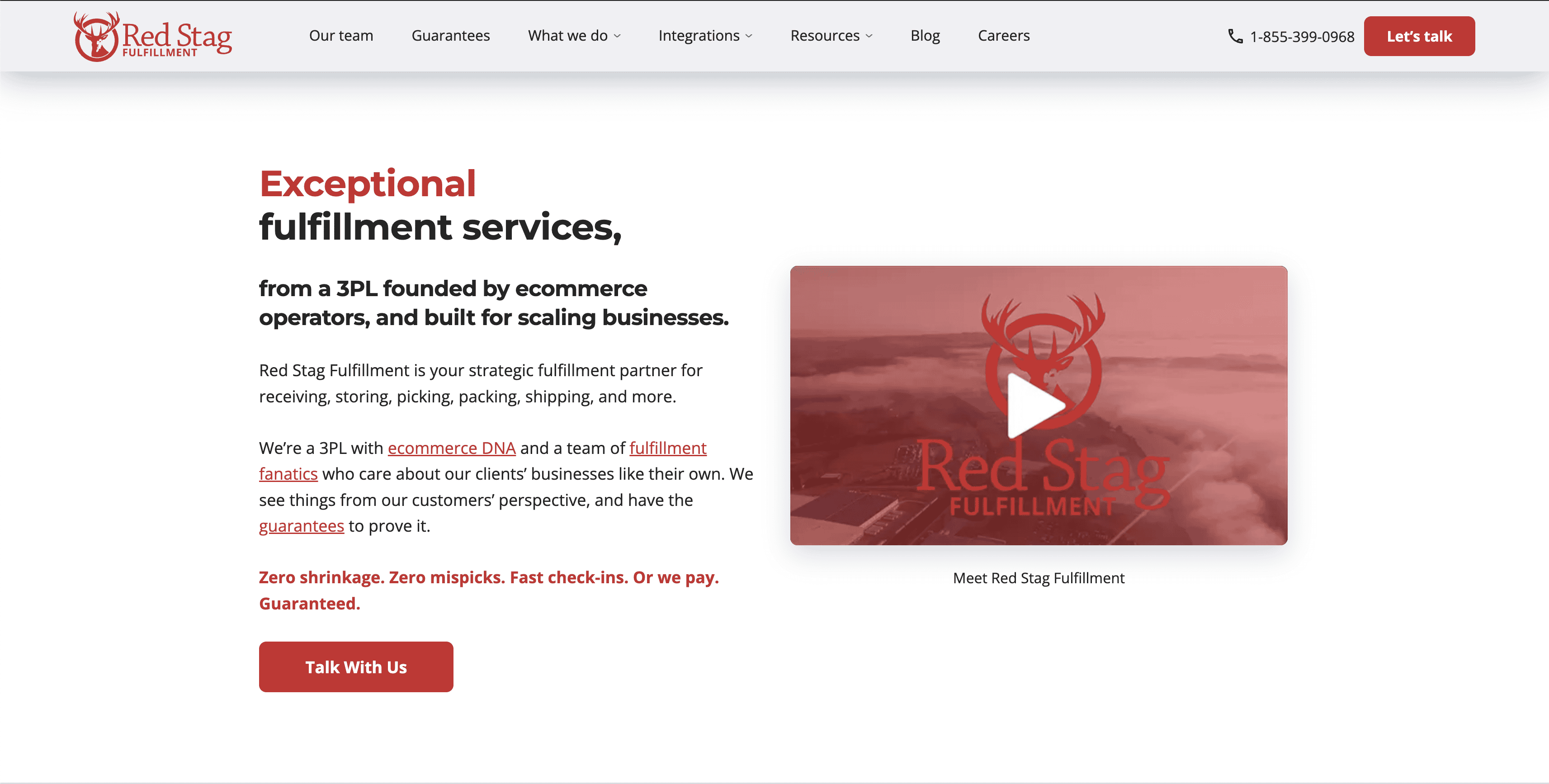
1) Red Stag Fulfillment
Best for: Shopify brands shipping heavy, bulky, oversized, fragile, or high-value products.
Consideration: Red Stag is built for demanding, high-value orders rather than rock-bottom pricing on small, light items. If your whole catalog is standard and lightweight, it’s worth comparing a few quotes.
We may be biased in placing Red Stag Fulfillment so high on the best 3PLs for Shopify list, but we think we might be the better choice for you. You be the judge.
As a top third party logistics company, Red Stag Fulfillment provides warehousing, order fulfillment, picking and packing, and reverse logistics. We also offer additional services to optimize your supply chain, like inventory management, SKU analysis, and demand planning.
Accuracy rates and delivery times
With Red Stag Fulfillment, you can reach 96% of U.S. homes within two days. That’s because our fulfillment centers are strategically located for lower landed costs and faster deliveries than some of our competitors.
We provide zero mispicks backed by our industry-leading guarantees. In the rare event a mistake occurs, we’ll make it right and credit you. Why? Because mistakes hurt your business, so it’s only right that they hurt us, too. This level of accountability lets you feel confident our priorities are always aligned with yours.
Pricing structure
Red Stag provides customers with full pricing transparency so you can better control your fulfillment costs. We design custom agreements based on your company’s specific details so our pricing matches exactly what you need—nothing more, nothing less.
With our accuracy guarantees, you can trust in pricing predictability, too. You’re never on the hook for the cost of the rare mistake.
Customer service
You can call Red Stag during our business hours and almost always get a live person to answer the phone. This is often a major selling point for Shopify merchants who may be used to dealing with chatbots and email threads for support.
Our dedicated experts resolve questions quickly and can help you discover opportunities to improve performance across all of your sales channels, not just Shopify.
Many of our Client Success team members started at Red Stag by working on the warehouse floor. They understand fulfillment inside and out and can guide you through all kinds of challenges, including cost optimizations and growth opportunities.
Other factors
We work across almost all product types, supporting Shopify stores and other omnichannel fulfillment needs. But we’re also one of the few 3PLs that can help you with large or heavy items.
Having a fulfillment partner that knows how to ship big, bulky products can help your business save money on packing and shipping. A great 3PL with experience can also limit damage risks, especially since larger items can be costly to return and replace.
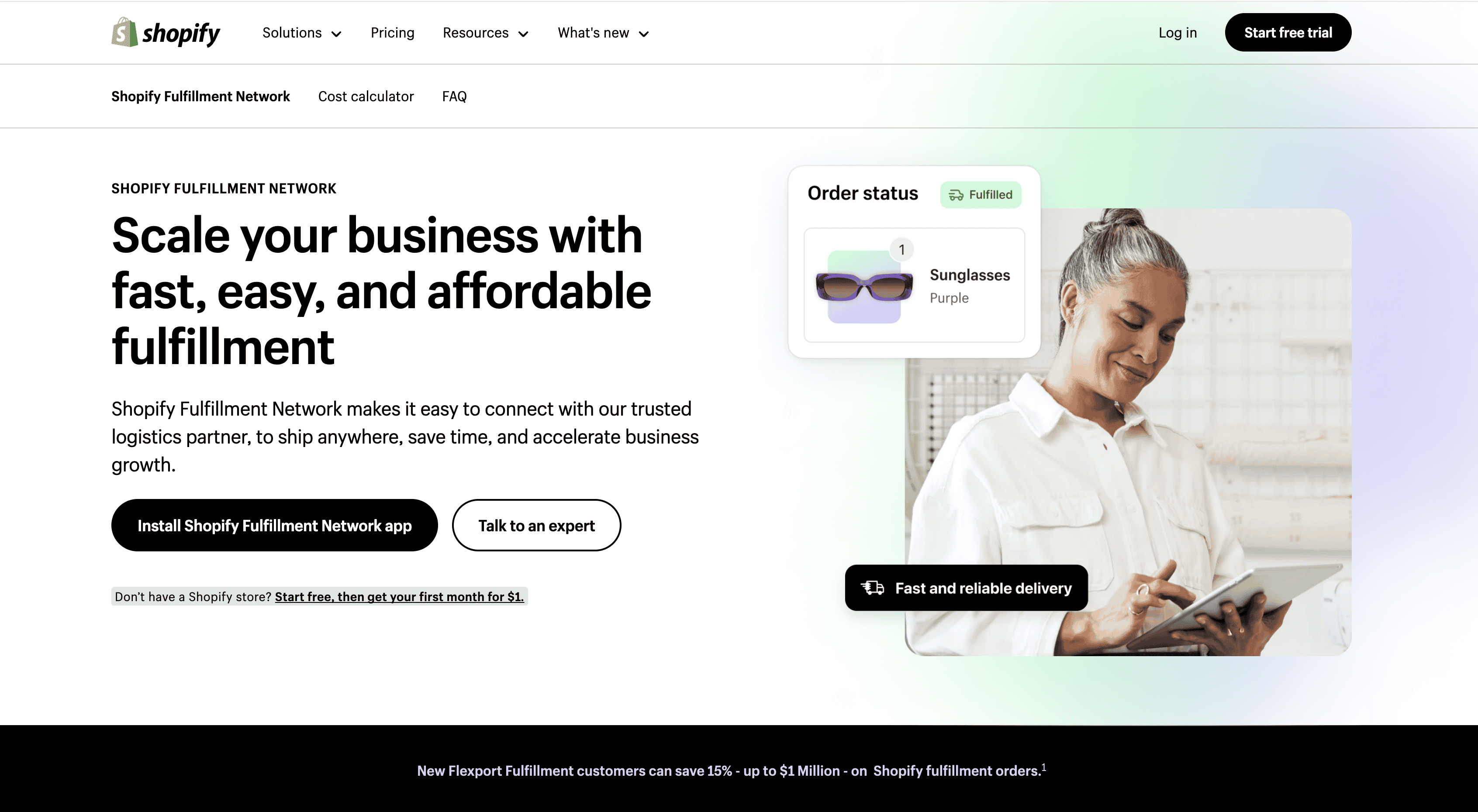
2) Shopify Fulfillment Network (powered by Flexport)
Best for: merchants who want fulfillment they manage from the Shopify admin, backed by Flexport’s warehouse network, with no minimums.
Consideration: since 2023 the fulfillment itself is run by Flexport, not Shopify. You’re really evaluating Flexport’s network and service levels, with Shopify as the software layer on top.
The Shopify Fulfillment Network (SFN) is a connector app now, not a warehouse operator. In 2023, Shopify sold its logistics business (including the Deliverr network it had paid $2.1B for) to Flexport, and SFN now routes your inventory and orders to Flexport’s fulfillment centers across the U.S. and Canada. You manage it from your Shopify admin: inventory storage, order picking and packing, shipping, and returns, plus orders from other channels like Amazon, Walmart, and eBay.
Accuracy and on-time rates
SFN doesn’t provide company-wide performance metrics for shipment accuracy and on-time deliveries. Customers can review these metrics for their shipments based on 30-, 60-, and 90-day periods on the SFN platform.
Pricing structure
Shopify Fulfillment Network offers weight-based unit pricing with volume-based storage fees that can be offset by multi-item discounts per order. The company also handles returns on a flat-fee basis. Prices may be higher than some competitors, but they provide scalable predictability that aligns costs with sales. There are no minimum order requirements or long-term contracts.
Customer service
Support runs through Flexport now. For anything touching warehousing or shipping, you log in to your Flexport account and click Talk to Support, with 24/7 access to Flexport’s logistics team. For app and store-connection issues, Shopify’s Help Center and 24/7 support cover the software side.
Other factors
SFN has strict partnership rules for merchants. Not following them could result in penalties. For example, if ecommerce merchants don’t provide tracking and estimated arrival times for inbound shipments, SFN may refuse the shipment or charge fees. Similarly, if shipments don’t match forecasted demand, SFN may refuse them or apply variance fees.
Because Flexport operates the fulfillment now, your experience depends on Flexport’s network rather than Shopify itself. If you’re weighing SFN against a dedicated 3PL, you’re really weighing Flexport.
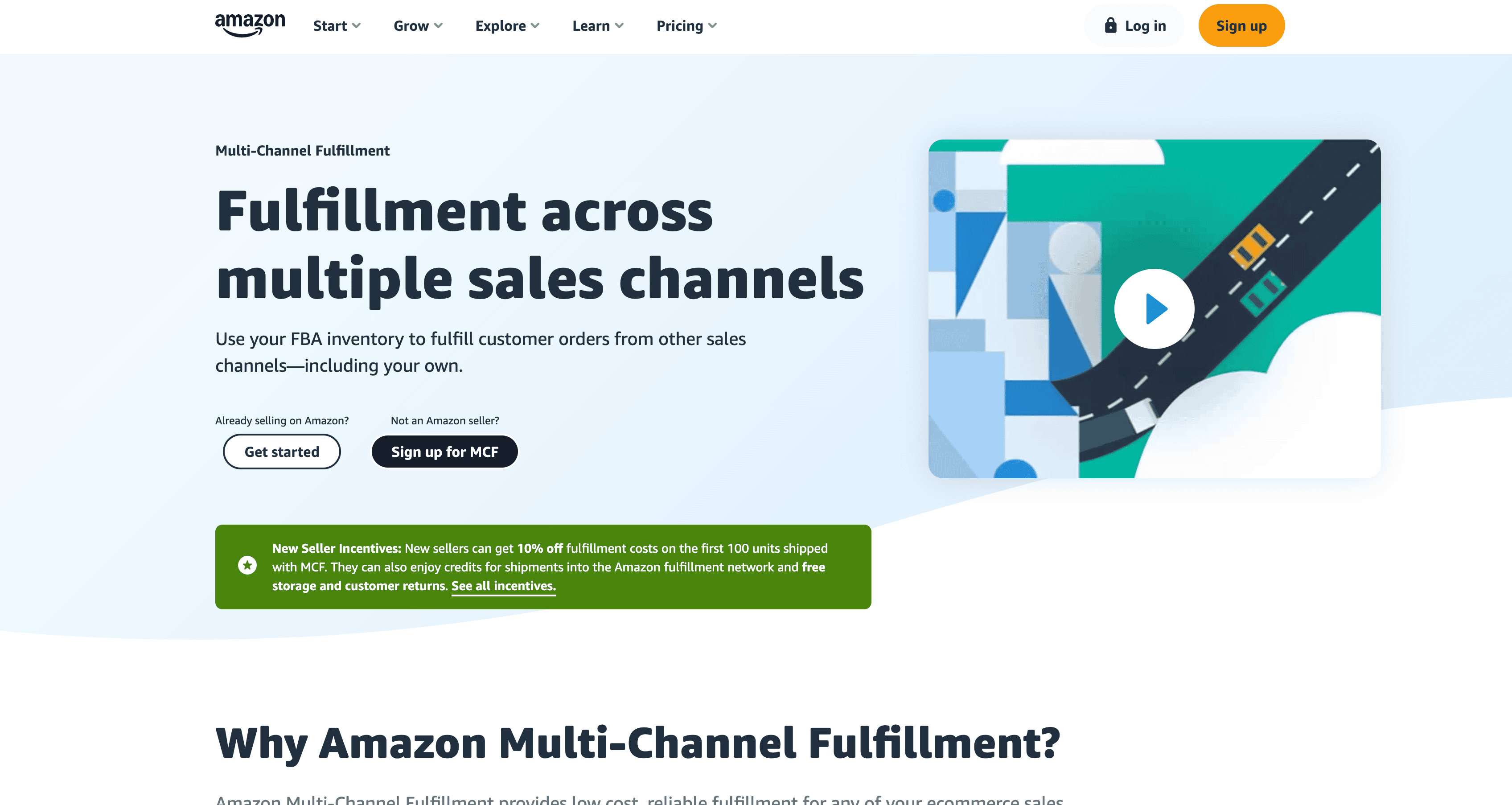
3) Amazon Multi-Channel Fulfillment
Best for: brands that want the widest possible warehouse footprint and already live in the Amazon ecosystem.
Consideration: Amazon leans hard on standardization. You can’t choose your packaging materials or your carriers, which matters if brand presentation or cost control is a priority.
Amazon Multi-Channel Fulfillment (MCF) is Amazon’s omnichannel fulfillment service. It’s separate from Fulfillment by Amazon, which caters to Amazon sales specifically. You can use MCF to handle orders from Shopify and other sales channels.
Accuracy rates and delivery times
Amazon MCF provides three delivery options: standard shipping, expedited shipping, and priority shipping. The company claims a 99.8% undamaged package delivery rate, based on small- and medium-sized business data. It also claims a higher than 97% on-time delivery, which is lower than some competitors.
Pricing structure
Amazon MCF provides transparent pricing, but its pricing tables and fee schedules can be time-consuming to review. You may experience a few surprises if you don’t thoroughly inspect how it uses details, like product category, size, and weight to determine pricing.
Customer service
MCF customers can access 24/7 customer service support with a seller log-in. There’s also a knowledge base with articles that self-starters can use to resolve issues and learn more about ways to improve logistics for their businesses.
Other factors
Amazon has approximately 1.5 million workers across 2,000 warehouses, so it has the labor and resources to provide reliable fulfillment for any size business—but it also relies heavily on standardization to meet demand.
This means you can’t specify your packaging materials or compare and choose your trucking carriers. If these factors are important for your cost control and brand presence, you may need a different 3PL.
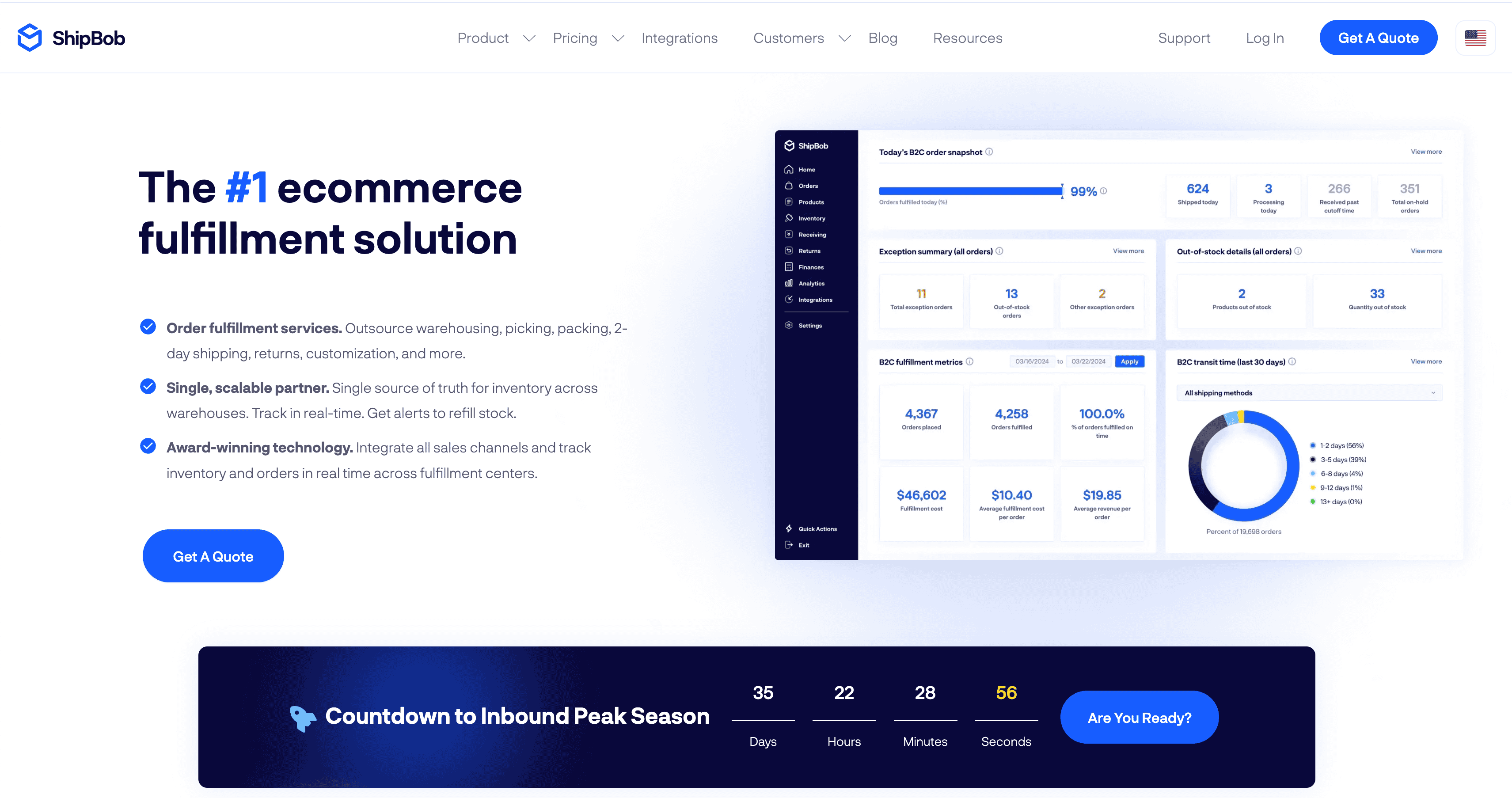
4) ShipBob
Best for: high-growth and international DTC brands that need global reach and a Shopify Plus-grade integration.
Consideration: ShipBob’s pricing and setup fees suit established stores with real monthly volume. Very early-stage brands may find it heavier than they need.
ShipBob is one of the most popular VC-backed 3PLs and offers warehousing, inventory management, picking and packing, shipping, and returns for Shopify stores and other sales channels. It focuses mainly on DTC fulfillment, but fulfills B2B orders, too.
Accuracy and on-time rates
ShipBob has more than 50 international fulfillment locations, so you can ship to almost every country using standard and expedited shipping options. In the U.S., you can reach customers within two days based on the number of warehouses you use. The 3PL claims a 99.96% on-time shipping rate and 99.95% accuracy rate.
Pricing structure
ShipBob customizes your pricing based on services like storage, order processing, pick and pack, and shipping. Beyond its core pricing, it may also provide additional pricing structures for customizations like branded packaging and kitting.
Customer service
ShipBob provides 24/7 customer support by phone, chat, and email to address questions, issues, and exceptions. It also provides training and education resources, including documentation, videos, and webinars, to help you set up and grow your business.
Other factors
ShipBob has recently expanded its social media fulfillment capabilities, so companies selling across Shopify and social may benefit from a 3PL partner that specializes in specific platforms like TikTok.
5) LVK Logistics (formerly ShipHero)
Best for: tech-forward operators who want granular, WMS-level control over fulfillment data and workflows.
Consideration: ShipHero the software and LVK the fulfillment service are now two different companies, so confirm which one you’re signing with. LVK’s roughly seven facilities are also a smaller footprint than ShipBob or Amazon.
ShipHero is a 3PL that provides warehousing, picking, packing, shipping, and reverse logistics. It focuses on technology to streamline the fulfillment process, citing its warehouse management system (WMS), internal mobile application for warehouse staff, and real-time analytics as its core strengths.
Accuracy and on-time rates
ShipHero doesn’t publish detailed fulfillment and shipment accuracy rates, but it claims its WMS supports an overall 99.99% accuracy rate. Its average fulfillment time is 3.5 days.
Pricing structure
ShipHero provides a custom flat-pricing structure based on per-order fulfillment fees for picking and packing. Additional fees apply for branded packaging, kitting, and other specialty fulfillment needs. Monthly storage fees are based on volume.
Customer service
Customers can access ShipHero customer support during business hours Monday to Friday and during shortened hours on Saturdays. For urgent matters after hours, an in-app ticketing system routes issues to customer support for follow-up. For more detailed help, you’ll need to schedule calls with their team.
Other factors
ShipHero the software and ShipHero the fulfillment service are no longer the same business. In 2024, ShipHero spun its fulfillment arm into a standalone 3PL called LVK Logistics, which runs on ShipHero’s warehouse management system across roughly seven facilities in the U.S. and Canada. So if you’re shopping for “ShipHero fulfillment,” check that you’re actually contracting with LVK, and ask which specific warehouse will hold your inventory. The well-known WMS and the fulfillment operation come from different companies now.
Honorable mentions for the best 3PLs for Shopify
- Shiphype
- AMZ Prep
What to know about Shopify 3PL companies
Searching “3PL” or “fulfillment” in the Shopify app store returns hundreds of results—but most aren’t actual 3PLs. Many are software connectors, shipping label generators, or broker platforms that route your orders to third-party warehouses you don’t control.
A Shopify 3PL should own or operate the warehouses where your inventory sits. They receive your products, store them, pick and pack orders when sales come in, and ship directly to your customers. If a provider can’t tell you exactly which facilities will handle your products, or if they’re just connecting you to someone else’s network, you’re adding a layer of complexity without gaining the accountability that makes outsourcing worthwhile.
A 2026 note on omnichannel and TikTok Shop
A 3PL can support one fulfillment operation across Shopify Markets, Amazon, and TikTok Shop. One thing to get right: TikTok Shop briefly announced it would end independent seller shipping in February 2026 and route U.S. sellers through its own logistics, then reversed that decision on February 17, 2026. Sellers can still fulfill TikTok Shop orders through their own 3PL. So if you sell on TikTok Shop, a partner that handles it alongside Shopify keeps you flexible without locking you into one platform’s logistics.
Shopify 3PL core capabilities to look for
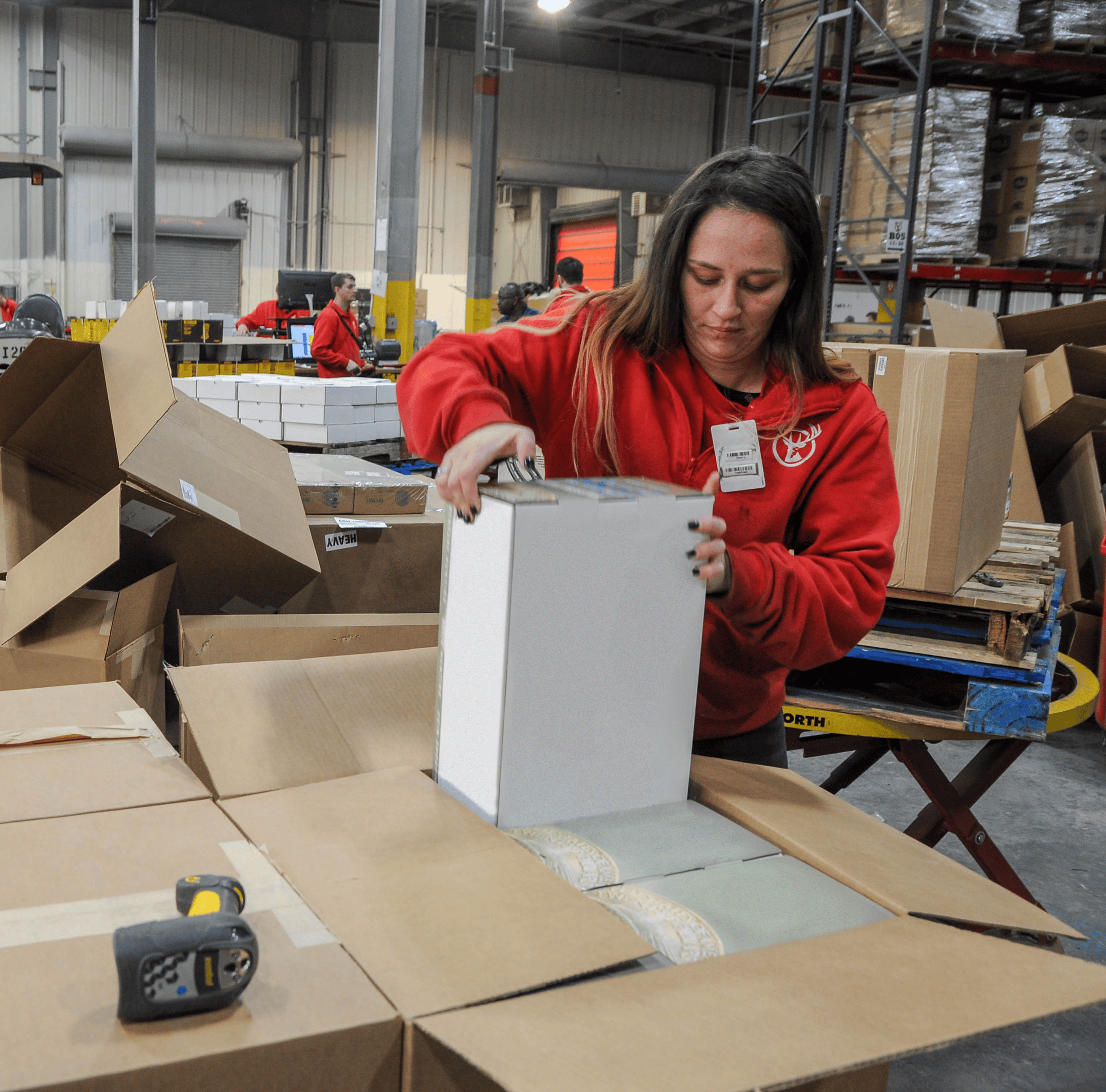
Every 3PL should handle receiving, warehousing, picking, packing, shipping, and returns. The difference between providers comes down to accuracy rates, technology integration, and how they handle exceptions. Here’s what each capability should look like for a Shopify store.
Receiving
Receiving is where inventory accuracy starts or breaks down. Warehouse staff check inbound shipments against purchase orders, verify quantities, inspect for damage, and log products into the warehouse management system. A 3PL with sloppy receiving creates phantom inventory—your Shopify store shows items in stock that don’t actually exist, leading to oversells and canceled orders. Ask prospective 3PLs how they handle receiving discrepancies and how quickly inbound shipments become available to sell.
Warehousing
Warehousing covers how and where your products are stored. A 3PL should slot your inventory based on velocity (fast-movers near packing stations), product dimensions, and any special requirements like climate control or hazmat compliance. Poor slotting increases pick times and error rates. For Shopify merchants with seasonal demand swings, confirm your 3PL offers flexible storage pricing so you’re not paying for empty shelf space in slow months.
Order fulfillment
When a Shopify order comes in, pickers retrieve items from warehouse locations and hand them to packers. The speed and accuracy of this process depends on the 3PL’s warehouse management system, pick methodology (batch picking, wave picking, zone picking), and staff training. If your store offers gift wrapping, custom inserts, or subscription boxes, confirm these instructions flow automatically from Shopify to the packing team—manual workarounds lead to missed requests and customer complaints.
Shipping
Shipping is the final step before your customer receives their order. The best Shopify 3PLs negotiate volume discounts with carriers like UPS, FedEx, and USPS—typically 15-30% below retail rates—and pass some of those savings to you. They also provide delivery estimates at checkout that they can actually meet. Ask for on-time delivery rates (look for 97%+) and clarify who pays when a carrier misses their SLA.
Reverse logistics
Returns cost ecommerce brands 15-30% of revenue on average, and poor returns handling makes it worse. A 3PL should receive returned items, inspect them, and either restock them under the original SKU or relist them as refurbished/discounted. Fast disposition—deciding what happens to each return—gets sellable inventory back into stock before you lose the next sale. Ask how long returns sit before processing and what percentage of returns are successfully restocked.
Other 3PL and supply chain services
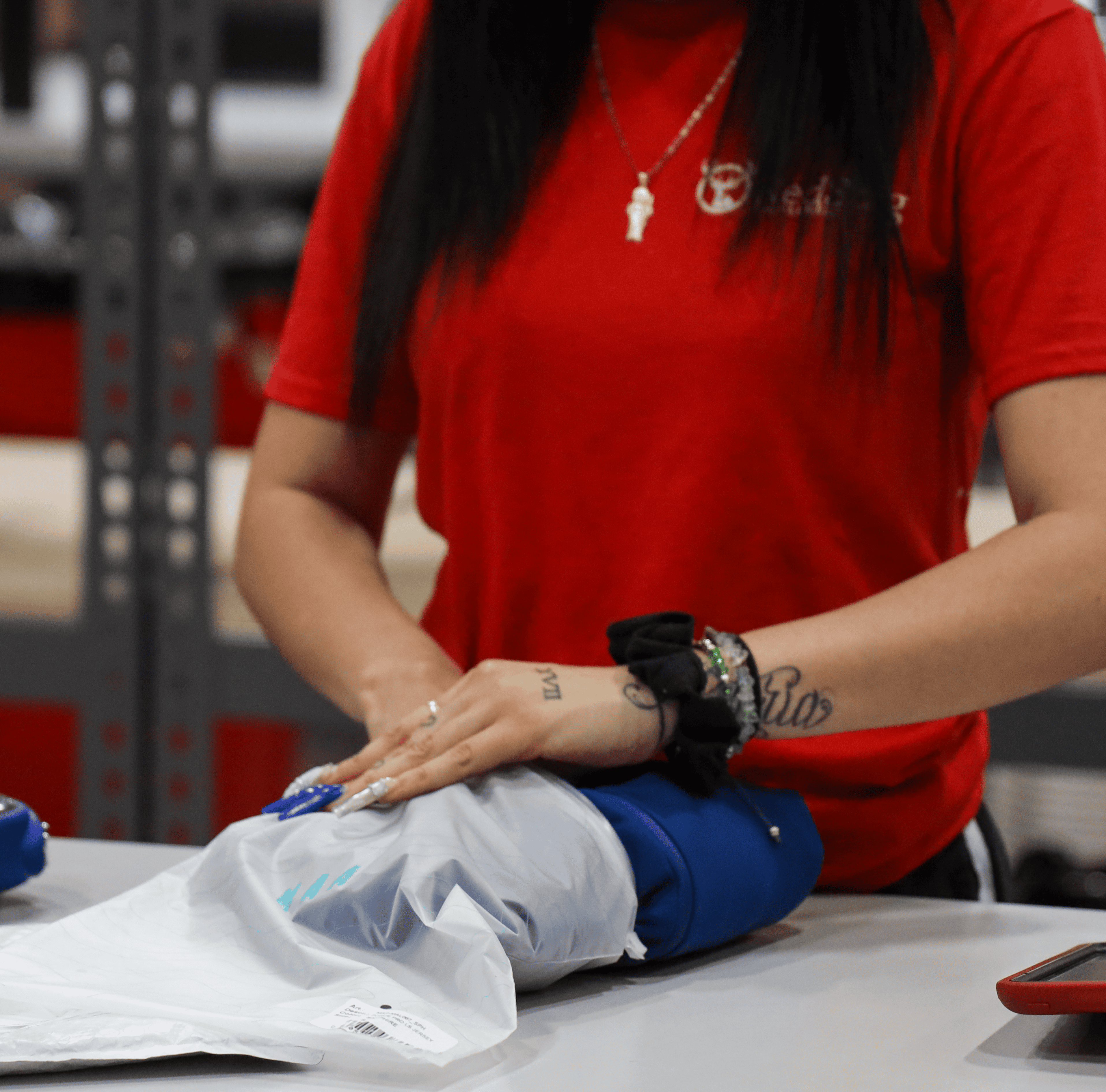
Core fulfillment—receiving, storing, picking, packing, shipping—is table stakes. The 3PLs that actually move the needle on profitability offer services that extend beyond the warehouse: freight coordination, inventory planning, demand forecasting, and value-added work like kitting. These capabilities matter most for Shopify merchants scaling past $1M in annual revenue or managing complex product catalogs.
Freight forwarding
Freight is how products move in bulk—from factories to ports to your 3PL’s warehouse. Some Shopify 3PLs coordinate this inbound logistics for you, leveraging their carrier relationships to negotiate better rates than you’d get on your own.
For merchants importing internationally, a 3PL with freight forwarding handles ocean or air shipping, customs brokerage, and duties calculation. This consolidates your supply chain under one partner instead of juggling separate freight forwarders, customs brokers, and warehouse providers. The cost savings vary, but merchants importing container loads often see 10-20% lower landed costs by routing freight through a 3PL’s existing contracts.
SKU analysis
SKU analysis identifies which products make money, which drain resources, and which need reordering before you stockout. A 3PL with this capability tracks sell-through rates, days of inventory on hand, and contribution margin by SKU—then flags when fast-movers need replenishment or slow-movers need markdowns.
This matters most for Shopify merchants with 100+ SKUs or those selling across multiple channels from consolidated inventory. Without SKU-level visibility, you’re guessing at purchase orders and discovering stockouts when customers complain. Ask whether your 3PL provides inventory dashboards and automated reorder alerts, or if you’ll need separate software.
Inventory management
Inventory management goes beyond counting stock. It includes demand forecasting, safety stock calculations, purchase order timing, and dead stock identification. Physical inventory—cycle counts, location accuracy, shrinkage tracking—is standard at any decent 3PL.
The strategic layer is where most Shopify merchants struggle. Forecasting demand, setting reorder points, and balancing carrying costs against stockout risk requires either dedicated headcount or a 3PL that offers inventory planning as a service. For brands doing $2M+ annually, outsourcing this to a 3PL with demand planning expertise often costs less than hiring an inventory analyst—and the 3PL has visibility into your actual warehouse data.
Kitting and assembly
Kitting bundles multiple SKUs into a single package—subscription boxes, gift sets, variety packs, or buy-one-get-one promotions. Brands using kitting typically see 15-25% higher average order values compared to selling items individually.
A 3PL handles kitting by pre-assembling bundles or building them on-demand when orders come in. The second approach (on-demand kitting) uses more labor but avoids inventory lockup—you’re not stuck with 500 pre-built holiday bundles that didn’t sell. For Shopify stores running subscription boxes, confirm your 3PL syncs kit components with your subscription platform (Recharge, Skio, Bold) so inventory decrements correctly across all SKUs.
Assembly is different from kitting. If your products ship unassembled or require configuration before packing—think furniture, electronics with multiple components, or customized items—look for a 3PL with light manufacturing capabilities. Assembling at the warehouse instead of the factory reduces damage risk and lets you offer more product variations without SKU explosion.
The best Shopify 3PL for heavy, bulky, and high-value products
The best Shopify 3PL for your business depends on what you ship, where your customers are, and how fast you’re growing. Most 3PLs optimize for small, lightweight products that fit neatly into standard boxes. If that’s your catalog, you have plenty of options. But if you ship heavy, bulky, oversized, or high-value products, most 3PLs will either reject you or charge punitive rates.
Red Stag Fulfillment specializes in the products other 3PLs struggle with: items over 10 lbs, oversized packaging, and high-value SKUs that need extra care. We back every order with our zero mispicks guarantee, and we pay you if we ever make a mistake, because any 3PL errors can cost you customers.
If you’re evaluating Shopify 3PLs and your products don’t fit the standard small-and-light mold, request a custom quote to see how our pricing compares. We’ll show you exactly what fulfillment costs look like for your catalog—no hidden fees, no surprises after you sign.
Shopify 3PL FAQs
How much does a Shopify 3PL cost?
Most Shopify 3PLs bill for four things: receiving, storage, pick-and-pack, and shipping. For small, light items, plan on roughly $3-6 per order plus monthly storage; heavy or oversized products cost more. The better providers quote against your real catalog instead of publishing one flat rate.
Does Shopify have its own fulfillment service?
Not on its own anymore. Shopify sold its logistics operation to Flexport in 2023. The Shopify Fulfillment Network (SFN) still exists as an app you manage from your Shopify admin, but the warehousing and shipping are handled by Flexport’s network. It’s a convenient option with no minimums or long-term contracts. Just know you’re really evaluating Flexport’s fulfillment, with Shopify as the software layer. A dedicated 3PL usually gives you more control over warehouse selection, packaging, and multi-channel inventory.
What’s the best 3PL for a small Shopify store?
Small stores usually want no minimums, predictable per-order pricing, and a native Shopify integration. SFN and ShipBob handle standard small-and-light catalogs well. Red Stag is the stronger choice if you ship heavy, bulky, or high-value products that other 3PLs reject or surcharge.
What’s the best 3PL for heavy or bulky Shopify products?
Red Stag Fulfillment is built for the items most 3PLs avoid: products over 10 lbs, oversized packaging, and high-value SKUs. Every order carries our zero mispicks guarantee, and Red Stag pays you if it gets one wrong.
How do I know if a Shopify app is a real 3PL?
A real 3PL owns or runs the warehouse where your inventory physically sits and can tell you exactly which facility will handle your products. A lot of Shopify “fulfillment” apps are just software connectors, label generators, or brokers that pass your orders to warehouses you never see.

